

Symbolic Rebellion: The Story Behind Lolo Goraseb’s Chains Outside Namibia’s Seat of Power
In the centre of Windhoek, a striking image has attracted attention both within Namibia and further afield: former footballer-turned-activist Lolo Goraseb, chained outside the Office of the Prime Minister. His dramatic protest against corruption and compromised autonomy within Namibia’s Public Service Commission has sparked fierce debates about governance, transparency, and accountability. Dubbed the “Chains of Integrity,” Goraseb’s bold act shines a spotlight on systemic rot, names individuals accused of dishonesty while challenging bureaucratic oppression head-on. As hashtags such as #FreeLolo and #IntegrityMatters gain traction on social media, this symbolic rebellion is prompting critical questions about the potential for meaningful reform and the possibility of harsh retaliation. Delve into the riveting account of this pivotal moment, which underscores the fragility and resilience of democracy in modern-day Namibia.
Chains of Integrity
The sun hung low over Windhoek, casting long shadows across the marble floors of Namibia’s Office of the Prime Minister. Lolo Goraseb stood at its entrance, his hands bound in chains—a theatrical flourish that would have seemed absurd if it weren’t so deeply serious. His face was a mask of grim determination, sweat pooling on his brow under the merciless African heat.
Formerly a celebrated footballer who once dribbled past defenders with grace and ease, Goraseb now found himself shackled by something far heavier than steel: bureaucracy, corruption, and disillusionment. He had come to deliver what he called “a statement of conscience,” though many whispered it was an act of madness—or rebellion.
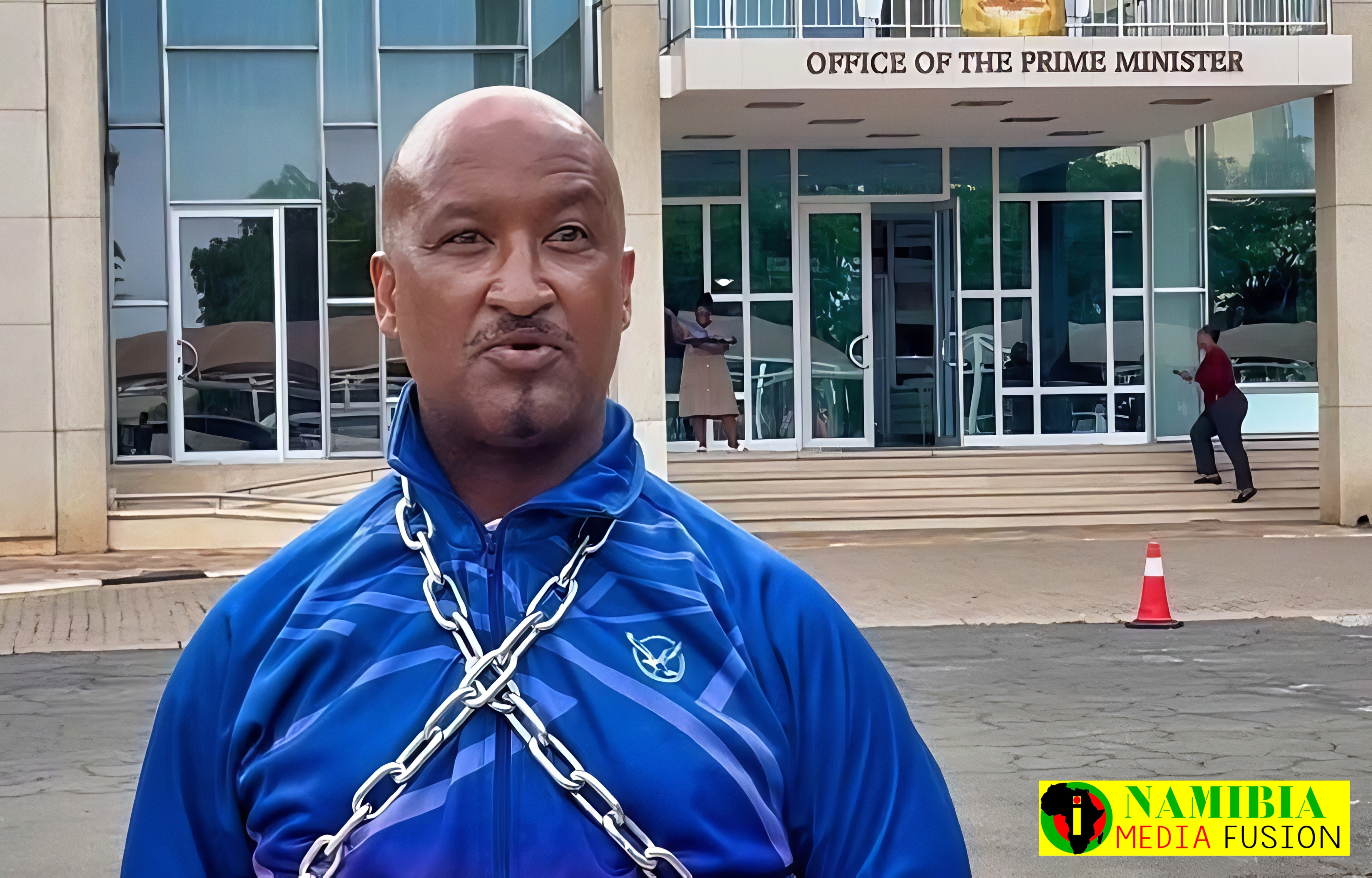
“Ladies and gentlemen of this great nation,” Goraseb began, his voice resonating like thunder as curious onlookers gathered around him. “Today, I stand before you not as a disgruntled employee but as a concerned citizen. The structural independence of our public service management has been compromised. It is time we address the rot festering within.”
His words cut through the air like a machete slicing through dense bushveld. A few journalists scrambled for their notebooks while others recorded his speech on their phones. Some passersby laughed nervously; others shook their heads in disbelief.
Goraseb went on to explain how the Public Service Commission (PSC), designed to be an impartial arbiter overseeing public service matters, had been reduced to little more than a marionette dancing to the strings pulled by the Office of the Prime Minister.
“It is supposed to operate independently!” he bellowed, tugging at his chains for emphasis. “But instead, it functions as a mere appendage of political power. How can we expect justice when the very body meant to uphold fairness is beholden to those it should hold accountable?”
He paused, scanning the crowd with piercing eyes. There was a flicker of vulnerability beneath his bravado—a man aware that he might be throwing away his career, perhaps even his freedom. Yet, there was also fire, unrelenting and fierce.
“The PSC itself has repeatedly advocated for autonomy,” he continued. “Yet here we are, still trapped in this web of interference. And do you know why? Because those in power fear accountability. They thrive on opacity, on secrecy. But enough is enough!”
At this point, murmurs rippled through the audience. Some nodded in agreement, recalling scandals they’d heard about or experienced firsthand. Others rolled their eyes, dismissing Goraseb as just another disgruntled ex-athlete trying to make noise after failing to adapt to life beyond the pitch.
But then Goraseb dropped his bombshell. With deliberate slowness, he named names—names of individuals occupying key positions within the Department of Public Service Management. According to him, these were people whose integrity had already been questioned under oath at the Labour Commission.
“One individual,” he said, pointing toward the towering building behind him, “was found dishonest and mischievous during official proceedings. Another leads the Division of Ethics and Integrity despite having demonstrated neither quality themselves. This is the rot we are referring to.”
A gasp rippled through the crowd. Even the sceptics leaned forward, intrigued. Could it really be true? Was the system so corrupt that it rewarded deceit rather than punishing it?
As if summoned by some cosmic force, I-Ben Nashandi appeared at the top of the stairs leading into the office. Dressed impeccably in a tailored suit, he looked every bit the consummate bureaucrat. His expression was calm, almost amused, as though watching a sideshow rather than confronting a potential crisis.
“All aggrieved employees know the proper channels to follow if they have grievances,” Nashandi announced coolly, addressing no one in particular yet everyone all at once. His tone carried a hint of condescension, as though implying that anyone resorting to such theatrics clearly lacked basic understanding of protocol.
Goraseb turned to face him, chains clinking softly against the ground. For a moment, the two men locked gazes—one defiant, the other dismissive. Then Goraseb smiled wryly.
“Ah, Mr. Nashandi,” he said, loud enough for everyone to hear. “Proper channels? You mean the same ones that protect dishonesty and reward misconduct? No, thank you. Today, I choose transparency over silence, truth over convenience.”
With that, he knelt down, deliberately placing himself lower than Nashandi both physically and symbolically. The gesture was unmistakable: submission, yes—but not to authority. The principle.
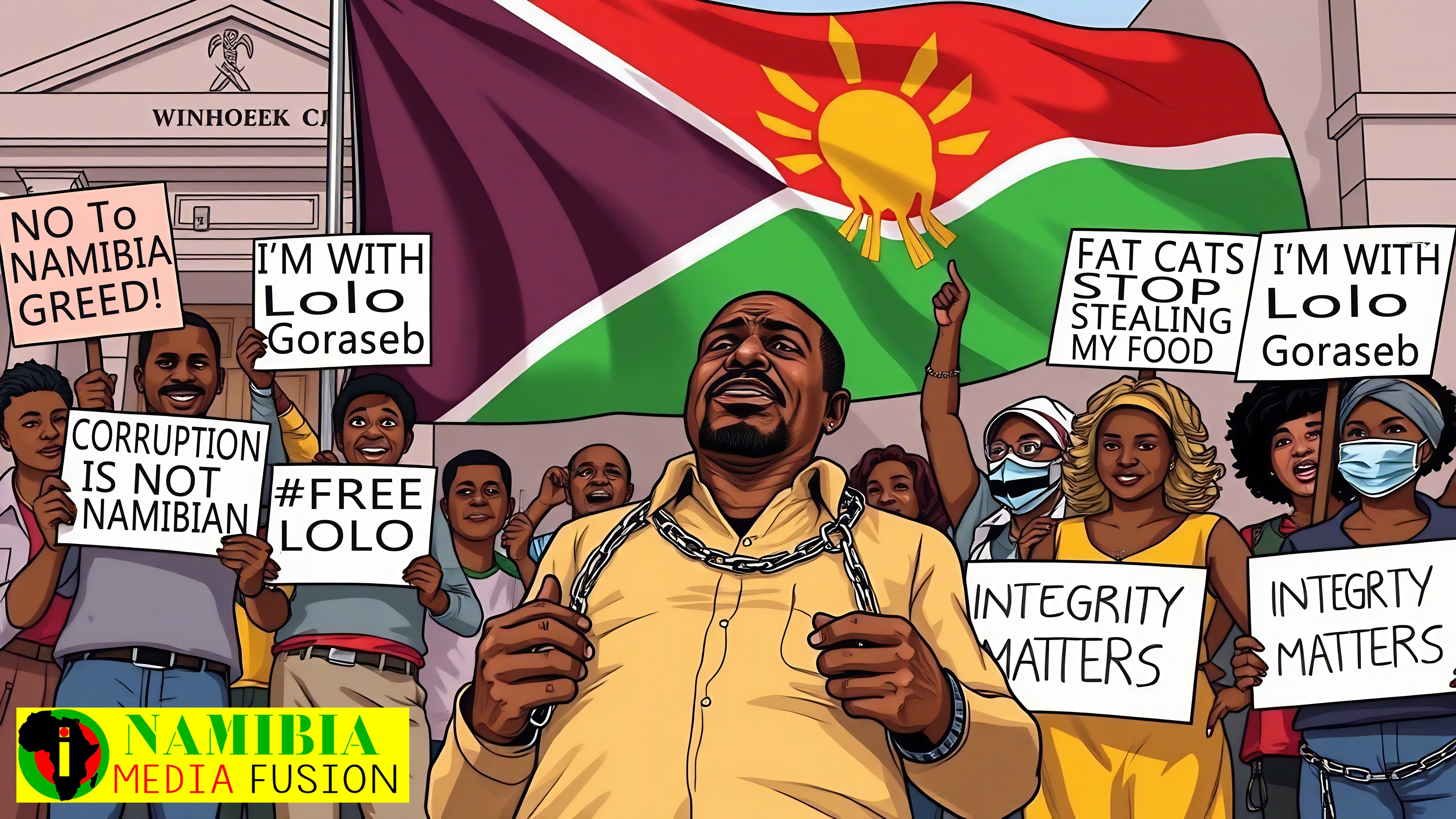
By evening, images of Goraseb chained outside the Office of the Prime Minister had gone viral. Social media erupted with hashtags like #FreeLolo and #IntegrityMatters. Debates raged online and offline about the state of Namibia’s public institutions. Critics accused Goraseb of grandstanding; supporters hailed him as a modern-day whistleblower.
Meanwhile, inside the hallowed halls of power, whispers grew louder. Would Goraseb’s bold move spark meaningful reform—or merely land him in deeper trouble? Only time would tell.
For now, though, one thing was certain: whether considered hero or fool, Lolo Goraseb had ignited a conversation too important to ignore. And every so often, that alone is victory enough.
Chains of Integrity: A Deeper Dive into the Tapestry of Corruption and Courage
The sun dipped lower, painting Windhoek’s skyline in hues of crimson and gold—a stark contrast to the darkness Lolo Goraseb was exposing. His chains glinted under the fading light, a cruel irony that seemed almost whimsical if it weren’t so brutally real. Here stood a man who had once been celebrated for his speed and agility on the football pitch, now reduced to standing still, tethered not by metal but by the weight of systemic rot.
Cruelty and Captivation
Goraseb’s plight was cruelly poetic. As a former athlete accustomed to freedom of movement, the chains were both literal and metaphorical—a symbol of how bureaucracy had ensnared him. Yet his presence captivated the crowd. Some laughed nervously at the absurdity of it all; others felt an eerie chill run down their spines. Was this performance art or revolution? Either way, it was impossible to look away.
“Do you see me?” he asked, tugging at the chains again. “These are not my shackles alone. They belong to every Namibian whose voice has been silenced by corruption.”
His words hung heavy in the air, provoking murmurs of agreement from some quarters while drawing sneers from others. One elderly woman leaned over to her companion, whispering, “He’s either mad as a hatter or braver than any of us will ever be.” The tension was palpable—each word Goraseb uttered felt like a match being struck in a room drenched in petrol.
Radicalism and Provocation
What made Goraseb’s act so radical wasn’t merely his critique of the Public Service Commission (PSC) but his willingness to name names. In Namibia, where accusations often remained veiled behind euphemisms, pointing fingers carried risks far greater than ridicule. It invited retribution.
“The head of the Department of Public Service Management,” he declared, his voice rising above the chatter, “was found guilty of dishonesty under oath. And yet, here they sit—untouchable, unaccountable!”
The crowd gasped collectively. Even those sceptical of Goraseb’s motives couldn’t help but feel a twinge of outrage. How could someone proven dishonest hold such power? The revelation was both exhilarating and chilling, igniting fury while reminding everyone just how entrenched the system had become.
I-Ben Nashandi’s arrival added another layer of drama. Dressed immaculately in a charcoal suit, he exuded authority—but also arrogance. When he spoke, his tone dripped with condescension, dismissing Goraseb’s theatrics as childish tantrums unworthy of serious consideration.
“All aggrieved employees know the proper channels…” he began, only to be interrupted by Goraseb’s sharp retort.
“Proper channels?” Goraseb spat out the phrase like bitter medicine. “You mean the labyrinth designed to silence dissent? No, thank you. I’ll take my chances out here, where the truth can breathe.”
Nashandi’s smirk faltered briefly before returning, colder this time. The exchange between the two men crackled with intensity—one defiant, the other dismissive. Their stand-off was less about policy and more about principle versus pragmatism.
Humour and Sinister Undertones
There was a strange humour in Goraseb’s actions, though it bordered on gallows wit. Who else would chain themselves to the gates of power, transforming a bureaucratic grievance into a public spectacle? Yet beneath the humour lay sinister undertones. For every laugh, there was a shiver of unease. What would happen to Goraseb after the cameras stopped rolling? Would he face retaliation—or worse?
“You think this is funny?” one young man shouted, clutching his phone as he filmed the scene. “This isn’t comedy. This is survival.”
And perhaps that was the crux of it. Goraseb’s protest wasn’t just about exposing corruption; it was about survival—the survival of integrity itself. If institutions like the PSC continued to operate as puppets of political interests, what hope did ordinary citizens have?
Corruption and Adventure
To call Namibia’s public service management corrupt was nothing new—it was practically folklore. But Goraseb’s decision to confront it head-on turned tragedy into adventure. He wasn’t just blowing the whistle; he was embarking on a quest, reminiscent of ancient heroes setting forth to slay dragons. Except his dragon wore a tailored suit and wielded memos instead of claws.

As night fell, the scene took on an eerie quality. Shadows danced across the marble facade of the Office of the Prime Minister, giving the impression of a haunted mansion rather than a seat of governance. Journalists scribbled furiously, capturing every detail of Goraseb’s speech. Social media buzzed with memes and hashtags, blending satire with sincerity.
#FreeLolo became both a rallying cry and a punchline. Memes depicted Goraseb as everything from a modern-day Spartacus to a knight jousting against windmills. Yet behind the humour lay a poignant reminder: the fight for justice often requires equal parts of courage and absurdity.
Thrilling Suspense and Heartwarming Solidarity
By evening, the gathering outside the office had grown into a small crowd. Strangers exchanged stories of their own encounters with corruption, finding solace in shared experiences. An elderly man recounted how his pension application had disappeared into bureaucratic limbo. A young woman spoke of being passed over for promotions despite stellar performance reviews. Each story reinforced Goraseb’s message: the system was broken, and fixing it required collective effort.
Yet the suspense lingered. Would Goraseb’s bold move lead to change—or backlash? Inside the building, whispers swirled. Officials debated whether to arrest him, ignore him, or spin his protest as evidence of transparency. Meanwhile, supporters rallied around him, offering water, food, and words of encouragement.
“It takes guts to do what you’re doing,” said one woman, pressing a cool bottle of water into his hands. “Whatever happens, we’ve got your back.”
Her kindness brought tears to Goraseb’s eyes, a rare moment of vulnerability amid the chaos. For all its brutality, the day had also revealed glimpses of humanity—heartwarming reminders that even in the darkest times, solidarity could shine through.
Eerie Intrigue and Exhilaration
As the hours passed, the atmosphere shifted. The initial shock gave way to exhilaration. People clapped and cheered, chanting slogans that echoed through the streets of Windhoek. Children climbed trees to get a better view, their laughter mingling with the gravity of the moment.
But there was still an undercurrent of eeriness. The knowledge that Goraseb might pay dearly for his defiance cast a shadow over the festivities. Would he lose his job? Face legal repercussions? Or worse, vanish quietly into the night like so many whistleblowers before him?
Despite these fears, something magical happened. Ordinary people began to believe—not in grand solutions, but in the possibility of change. Goraseb’s chains became a symbol not of imprisonment but of liberation. By binding himself, he had freed others to speak their truths.
Mystery and Conclusion
By midnight, the crowd began to disperse, leaving Goraseb alone with his thoughts—and his chains. Lights flickered off in the Office of the Prime Minister, plunging the building into darkness. Somewhere within, Nashandi likely sat strategising, plotting his next move.
Goraseb knelt once more, bowing his head as if in prayer. Was he defeated? Or simply gathering strength for the battles ahead? Only time would tell.
For now, though, the city slept uneasy, haunted by questions left unanswered. Had Goraseb sparked a revolution—or merely lit a spark destined to fizzle out? Whatever the outcome, one thing was certain: he had reminded Namibia of its power to dream, to resist, to demand better.
And occasionally, that alone is enough to keep hope alive.
In Solidarity with Lolo Goraseb!!

- From Policy to Impact: Namibia’s Government Vows Overhaul at Windhoek Retreat - 7 December 2025
- The Man in Chains: Lolo Goraseb Exposes Rot in Namibia’s Public Service Management - 26 March 2025
- Driving Progress in Namibia: The Role of Digital Identity, Renewable Energy, and PR Strategies - 26 March 2025