

A Watershed of Honesty: Namibia’s Cabinet Retreat and the Quest for Transformative Governance
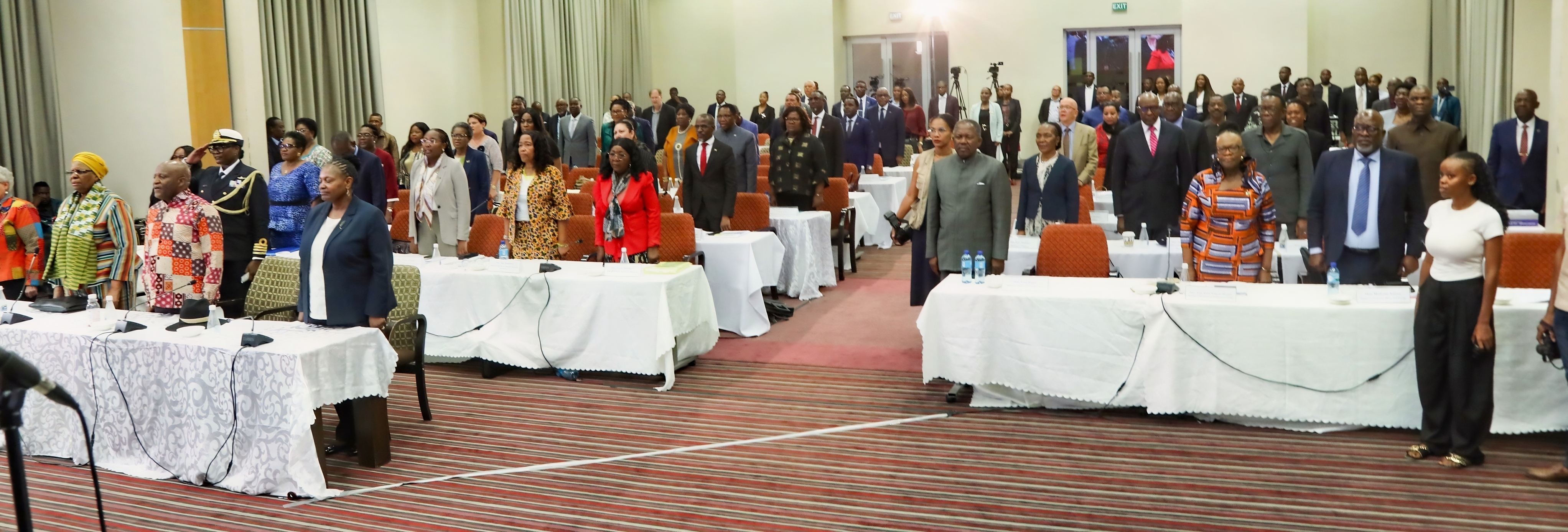
The convening of Namibia’s first Cabinet Retreat under the Netumbo Nandi-Ndaitwah administration in Windhoek represented far more than a procedural gathering; it was a watershed moment of institutional self-reflection. In a striking departure from the norm, the nation’s most senior leaders engaged in a candid, systemic audit of the state’s own machinery, moving from a culture of defence to one of diagnosis. Chaired by Her Excellency Lucia Witbooi, Vice President of the Republic of Namibia, whose opening insistence that “ethical leadership is non-negotiable” set the moral tone, the retreat transitioned from political rhetoric to a forensic examination of the chasm between policy ambition and lived reality for Namibian citizens. This article provides a comprehensive analysis of this pivotal event, exploring how its stark diagnosis and resulting covenant for action aim to redefine governance from the ground up.
Faced with a renewed electoral mandate, the Cabinet engaged in an unprecedented critique of the very structures they oversee. The discussions pinpointed deep-seated pathologies: obstructive legislation better suited to a first-world context hampering a developing nation, the insidious creep of institutional corruption that perverts systems from within, and a recruitment crisis where patronage routinely trumps merit. The retreat’s language was unflinchingly direct, labelling underperforming State-Owned Enterprises (SOEs) as internal “colons” that drain rather than develop the nation, and identifying procurement not as a mere process, but as the primary arterial sclerosis choking service delivery.
 Central to the new agenda emerging from Windhoek is a fundamental philosophical shift: the move towards a “results-based cabinet.” This mandates that every ministerial priority, budget allocation, and key performance indicator must be inextricably linked to the tangible outcomes of the National Development Plan (NDP6) and Vision 2030. This is coupled with bold, time-bound economic targets, such as securing Final Investment Decisions (FIDs) in the transformative oil and gas sector by 2026 and reforming fishing quota auctions to ensure maximum national revenue—priorities treated as national imperatives rather than departmental projects.
The Guiding Adage: “A stitch in time saves nine.”
This adage encapsulates perfectly the strategic imperative underpinning the retreat’s confrontational honesty. The “stitch in time” is the proactive, if uncomfortable, systemic diagnosis and the commitment to immediate, targeted reforms. The “nine” it aims to save represents the far greater, catastrophic cost of inaction: the complete erosion of public trust, perpetual economic stagnation, and the eventual failure of the national development project itself.
By choosing to confront the broken seams openly in governance—the flawed laws, the corrupted processes, the unaccountable institutions—the administration is attempting to make necessary repairs before the entire fabric of the state unravels. The adage justifies the retreat’s rare self-critique as a necessary, prudent investment to avert a much larger and more damaging crisis in the future.
 The conclave concluded not with self-congratulation but with a solemn covenant, underscored by the singing of the national anthem—a poignant reminder that the current struggle is for economic liberation and dignified service delivery. The critical question now hanging over the Windhoek resolutions is one of agency. This moment of profound introspection has set a new benchmark for accountability. The true test for the Nandi-Ndaitwah administration is whether this watershed will be followed by the relentless, coordinated action required to translate a stark diagnosis into a healed and effective system of governance, finally delivering measurable progress for all Namibians.
The Body: Twenty Pillars of Reflection and Resolution
-
A Deeper Look: The Foundation & The Mandate in Namibia’s Governance Journey
The opening premise of Namibia’s cabinet retreat—acknowledging a strong foundation while embracing a renewed mandate—is far more than ceremonial politeness. It represents a critical, strategic stance on national development, deeply contextualised within the Namibian experience. To understand this fully, one must appreciate what constitutes this “foundation” and how the “mandate” imposes a specific duty to build upon it, rather than to reinvent.

The Namibian Foundation: More Than Bricks and Mortar
Since independence in 1990, Namibia has meticulously constructed a state apparatus admired across the continent. This foundation is multifaceted:
-
Constitutional Bedrock: Namibia’s Constitution, born from the struggle, remains a cornerstone of stability. It enshrines democracy, the rule of law, and fundamental human rights, providing an unwavering framework for governance.
-
Macro-Economic Stability: Prudent fiscal management has, by and large, maintained economic stability. Institutions like the Bank of Namibia have built credibility, avoiding the hyperinflation or debt crises that have plagued others.
-
Policy Architecture: As noted in the retreat, Namibia has a robust suite of national policies. From the long-term Vision 2030 to successive National Development Plans (NDPs) and the Harambee Prosperity Plan, the nation has never lacked for detailed blueprints targeting poverty, infrastructure, and education.
-
Physical Infrastructure: Significant investment has created a network of roads, ports, and telecommunications that, while requiring maintenance and expansion, form a critical skeleton for commerce and connectivity, particularly in an expansive, arid country.
-
Social Cohesion: Relative peace and the absence of deep ethnic conflict post-independence is an intangible but priceless asset. It provides the social stability necessary for development.
The 2025 Mandate: A Directive for Decisive Progress
The November 2025 elections, which returned SWAPO and President Netumbo Nandi-Ndaitwah with a renewed majority, were not a blank cheque. Analysed through the retreat’s dialogue, the mandate was interpreted as a clear, if impatient, instruction from the electorate. Citizens, while acknowledging past progress, voted for accelerated and tangible results on pressing issues: unemployment, particularly among the youth; the high cost of living; housing shortages; and perceived service delivery failures.
The mandate, therefore, is not permission to simply continue. It is a charge to diagnose and overcome the bottlenecks that have prevented the solid foundation from translating into universal prosperity. It is an instruction to make the system work for the people.
Building Decisively Upon the Base: The Imperative
This is where the strategic nuance lies. The retreat’s consensus that “the task is not to start anew” is a rejection of both revolutionary upheaval—which would waste hard-won assets—and of complacent inertia. The approach is one of evolutionary repair and acceleration.
For instance:
-
On Policy: They are not discarding Vision 2030 or the NDPs. Instead, the focus is on fixing the “mechanisms”—the regulations, procurement laws, and bureaucratic cultures—that stifle their implementation.
-
On Institutions: The goal is not to abolish state-owned enterprises (SOEs) but to radically reform their governance, align them with national priorities, and install leadership based on merit.
-
On Infrastructure: It is about enhancing and maintaining existing networks while leveraging them for new economic sectors like green hydrogen and oil & gas, ensuring these resources benefit the foundational economy.
The Guiding Adage: “A House Built on Solid Rock Cannot Be Shaken”
This well-known adage encapsulates perfectly the retreat’s philosophy. Namibia’s first three decades of independence were spent, with considerable effort, laying that solid rock: the constitutional order, democratic traditions, and institutional frameworks. The “storms” of global economic volatility, domestic unemployment, and public frustration are now testing the structure.
The mandate of 2025 is a call to ensure the house upon this rock is not only sturdy, but also fully habitable—with all rooms (sectors) finished and functioning for all inhabitants (citizens). It would be folly to abandon the solid rock because the roof leaks or the plumbing is slow. The sensible, decisive action is to skillfully repair and extend the existing house, using its strong base to support a more ambitious, inclusive, and resilient structure.
In essence, Namibia’s leadership, through this retreat, has committed to a path of pragmatic evolution. They are custodians of a foundation laid by sacrifice and struggle. Their renewed mandate is a charge to be the architects who finally deliver the complete, thriving edifice of prosperity that foundation was always meant to support. The work, as they acknowledged, must now be done with unparalleled agency and impact.
-
-
A Deeper Look: The Central Imperative – Impact in Namibia’s Governance
The resolute declaration that government success must be “felt and appreciated by the citizens of Namibia” transcends a mere performance metric. It represents a fundamental philosophical shift, a rectification of the disconnect between policy intention and lived reality, and the core of the social contract in post-2025 Namibia. This imperative for tangible impact is a direct response to a specific national context, where theoretical progress has too often failed to materialise at the kitchen table.
The Critique Within the Call
The emphasis on felt impact is, implicitly, a critique of a past where success was often measured by inputs and activities rather than outcomes. It questions a system where:
-
A ministry may report “100 community consultations held” (activity) while the underlying issue of land delivery remains stalled (lack of impact).
-
A state-owned enterprise may celebrate “record turnover” (internal recognition) while its service reliability deteriorates and tariffs rise (negative public impact).
-
A new piece of legislation may be hailed as world-class (policy achievement) yet be so encumbered by complex regulations that it stifles the very businesses it aimed to help (implementation failure).
In the Namibian setting, with its vast distances and socio-economic disparities, a policy crafted in Windhoek can seem abstract in Outapi, Opuwo, or Karasburg unless it directly alters daily life—through a job, a reliable water supply, a quicker business licence, or a more responsive clinic.
Defining ‘Felt Impact’ in the Namibian Context
For the Namibian citizen, impact is not an abstract GDP figure. It is sensory and practical:
-
Economic Impact: It is money in pockets. It is a young graduate in Katutura finding meaningful employment, not just another internship. It is a farmer in the Zambezi region getting a fair price for their produce and accessing markets without prohibitive transport costs.
-
Service Delivery Impact: It is time saved and dignity restored. It is receiving a national ID or a birth certificate within days, not months. It is a mother at Rundu State Hospital experiencing competent, empathetic care. It is knowing that a report of a burst pipe will trigger a repair, not disappear into bureaucratic oblivion.
-
Psychological Impact: It is the restoration of trust and the feeling of being seen. It is the belief that the state is a functional partner in one’s aspirations, not a distant, capricious obstacle. It is the sense that fairness and merit have a chance against patronage and inertia.
The Guiding Adage: “The Proof of the Pudding is in the Eating”
This timeless adage cuts directly to the heart of the retreat’s imperative. A chef may use the finest ingredients (good policies), follow a celebrated recipe (Vision 2030, NDP6), and present a beautifully decorated dish (press releases, launch events). However, none of this matters if the pudding itself, when finally tasted, is unpalatable, stale, or never reaches the diner’s table.
The “eating” is the citizen’s experience. The “proof” is in their subjective, real-world assessment of improvement in their own lives. The government’s challenge is to move from being obsessed with the recipe and the presentation of the pudding, to being obsessively focused on ensuring every citizen gets a satisfactory, nourishing portion. This requires constant tasting (monitoring and evaluation), adjusting the recipe (policy refinement), and fixing the delivery system (governance reforms) based on that direct feedback.
From Aspiration to Operational Reality
Making this imperative operational requires a revolution in how government measures itself:
-
Metrics That Matter: Shifting from tracking budgets spent to tracking outcomes achieved—e.g., not “budget allocated for housing,” but “x number of affordable, title-deeded houses occupied by low-income families in Swakopmund.”
-
Listening as a System: Institutionalising genuine public feedback loops, moving beyond staged consultations to using digital platforms, civil society partnerships, and empowered local authorities to gather real-time data on public sentiment.
-
Accountability for Impact: Holding ministers and executive directors accountable not for activity, but for delivering pre-defined, citizen-centric outcomes, with consequences for failure.
In conclusion, this central imperative is the ethical and practical core of the renewed mandate. It acknowledges that the legitimacy of the government is no longer derived solely from the liberation struggle legacy or electoral victory, but is earned daily through demonstrable, positive impact on the lives of ordinary Namibians. It is a commitment to ensure that the nation’s considerable potential, and its solid foundation, finally yields a harvest that every citizen can taste and benefit from. The era of government as an activity is declared over; the era of government as an agent of tangible, felt results has begun.
-
-
A Deeper Look: Policy vs. Implementation – Namibia’s Governance Paradox
The candid admission at Namibia’s cabinet retreat—that the nation boasts “some of the best policies” yet suffers from flawed implementation—strikes at the heart of a longstanding national paradox. It is an acknowledgment that Namibia’s developmental challenge is increasingly less about what to do, and overwhelmingly about how to get it done. This gap between impeccable design on paper and stuttering execution on the ground represents the single most critical barrier to achieving Vision 2030 and the objectives of the Harambee Prosperity Plan.
The Strength of the Policy Edifice
Namibia’s policy framework is indeed robust and often lauded. Informed by the aspirational Vision 2030, it is characterised by:
-
Progressive Intent: Policies on gender equality, environmental conservation, communal land reform, and social welfare are intellectually sound and morally aligned with constitutional values.
-
Comprehensive Planning: Documents like the National Development Plans (NDPs) are detailed, with structured goals, indicators, and budgetary alignments.
-
Global Alignment: Namibian policies frequently incorporate best practices and align with international frameworks like the UN Sustainable Development Goals (SDGs).
From the Green Hydrogen and Synthetic Fuels Strategy to the latest NDP, the blueprint for a prosperous, inclusive, and sustainable Namibia clearly exists.
The Flawed Machinery of Execution
However, the retreat identified that the mechanisms translating policy into reality are where the system fractures. These obstructive flaws are multifaceted:
-
Regulatory and Legislative Bottlenecks: As President Netumbo Nandi-Ndaitwah highlighted, laws and regulations often act as brakes. Procurement laws designed for absolute, risk-averse probity can be so cumbersome they delay critical projects for years. Compliance processes can be duplicated across ministries, creating a “Kafkaesque” maze for citizens and investors.
-
The Capacity Chasm: Policies often assume a level of administrative and technical capacity that does not exist uniformly across the public service. A policy may mandate complex monitoring, but the relevant ministry may lack the data systems, skilled accountants, or engineers to execute it. This leads to implementation by half-measures or not at all.
-
Siloed Operations and Poor Coordination: A brilliant agricultural policy requiring seamless coordination between the Ministries of Agriculture, Water, Finance, and Works can falter if these entities operate in isolation. Lack of integrated data systems and inter-ministerial committees that meet in earnest cripples cross-cutting initiatives.
-
Budgetary Disconnect: Policies are not always matched with realistic, timely, and flexible budget allocations. A policy may be approved, but its implementation waits years for a budget line, or receives funding insufficient for its ambitions, guaranteeing failure.
-
Weak Monitoring, Evaluation, and Accountability: The system has traditionally been better at announcing policies than at relentlessly tracking their progress and holding officials accountable for delays. Without consequence for non-implementation, urgency dissipates.
The Namibian Consequences
This implementation deficit has direct, felt consequences:
-
A perfect policy on small and medium enterprise (SME) support fails if aspiring entrepreneurs cannot navigate the business registration or licensing process.
-
A world-class education sector policy falters if school infrastructure projects are perpetually stalled by procurement disputes.
-
A visionary land delivery policy becomes a source of frustration if the surveying, titling, and administrative processes are glacially slow.
The Guiding Adage: “The Map is Not the Territory”
This adage encapsulates perfectly Namibia’s policy-implementation dilemma. The policy document is the map—a refined, abstract representation of the desired destination and route. It is clean, logical, and born of careful study. However, the territory is the messy, unpredictable reality of Namibia’s bureaucratic landscape, capacity constraints, regional disparities, and political economy.
The flaw has been expecting the map to alter the territory by mere decree. The government has produced excellent maps (policies) but has not invested sufficiently in training the drivers (civil servants), maintaining the vehicles (systems and budgets), clearing the roadblocks (obstructive regulations), or ensuring all passengers (different ministries) are heading the same way. The retreat’s insight is that future effort must focus obsessively on mastering the territory of implementation.
The Path Forward: Fixing the Machinery
The retreat’s conclusion moves beyond lamentation to a clear mandate: stop solely perfecting the map. The task now is to:
-
Review and Amend Obstructive Laws: Prioritise legislative surgery to make laws enablers of development, not guardians of inertia.
-
Invest in Implementation Capacity: Target training, digitalisation, and recruitment of technical skills specifically for the execution of high-priority policies.
-
Enforce Orchestrated Coordination: Mandate and fund joint implementation units for cross-cutting policies, with clear lead and support responsibilities.
-
Institute Rigorous Delivery Tracking: Implement a publicly visible dashboard for key policies, creating relentless pressure for progress and accountability.
In essence, Namibia is shifting from being a policy-formulating state to becoming a policy-executing state. The recognition that “the best-laid plans of mice and men oft go awry” is not an excuse for resignation, but a diagnosis. The nation’s leadership has now committed to the less glamorous, but utterly vital, work of building the resilient, agile, and capable machinery required to traverse the distance finally between their exemplary maps and the promised land of tangible national progress.
-
-
A Deeper Look: Laws That Bind, Not Build – The Dysfunction of Legislative Misalignment
President Netumbo Nandi-Ndaitwah’s stark observation that some Namibian laws are “designed for the first world, while we are in the third world” is a profound critique of post-colonial governance. It moves beyond mere criticism of bureaucracy to identify a fundamental legislative mismatch—where the statutes meant to order society and catalyse development instead act as a drag anchor, preserving outdated complexities or importing unsuitable foreign models that ignore local realities.
The Anatomy of a “First World” Law in a Namibian Context
These “first world” laws are not inherently bad. Their flaw lies in their lack of contextual adaptation. They often exhibit:
-
Assumptions of Pervasive Capacity: They presume the existence of a deep bench of highly specialised civil servants, ubiquitous digital infrastructure, and easy public access to legal and technical advice—conditions more typical of a G7 nation than a sparsely populated country facing a skills shortage.
-
Risk Aversion Over Pragmatism: Designed for mature economies with vast regulatory resources, they prioritise the elimination of all risk (especially financial and procedural) above all else. In a developing context, this creates paralysis. For example, procurement laws so focused on preventing any conceivable irregularity can delay a critical clinic or school for years, causing far greater societal harm than the theoretical risk they mitigate.
-
Complexity as a Default: They layer multiple stages of approval, oversight, and reporting, requiring significant administrative overhead. In a “first world” setting with large institutions, this is manageable. In Namibia, it overwhelms under-staffed ministries and municipal offices, turning simple processes into epic journeys.
-
Neglect of the Informal & Rural Reality: Many laws are drafted for formal, urban economies. They fail to account for the subsistence farmer in the Ohangwena Region, the informal trader in Katutura, or the community-based tourism project in ≠Khoadi-//Hôas. The cost of compliance can be prohibitive, forcing many into illegality or excluding them from the formal economy altogether.
Consequences: When Law Becomes an Obstacle
The result is what the President termed laws that “act as brakes on progress”:
-
Stifled Enterprise: An aspiring entrepreneur in Walvis Bay may have a viable business idea but is stifled by a months-long process to obtain licences, permits, and approvals from a dozen different entities, each with its own “first world” compliance demands.
-
Infrastructure Delays: The urgent upgrade to the B1 highway or a new water purification plant can be bogged down in endless environmental impact assessments, procurement appeals, and contractual reviews that ignore the imperative of timely delivery.
-
Resource Paradox: Namibia discovers oil and green hydrogen potential—game-changers for the economy. Yet, the existing legal framework for public-private partnerships (PPPs) and benefit-sharing may be so convoluted and risk-averse that it deters the very investment needed to develop these resources.
-
Erosion of Trust: When citizens experience the state primarily as a source of obstructive red tape rather than enabling service, the social contract erodes. Law is seen not as a protector but as a persecutor.
The Guiding Adage: “A Square Peg in a Round Hole”
This adage encapsulates perfectly the problem. The “square peg” represents the rigid, imported, or anachronistic legal framework designed for a different context. The “round hole” is the complex, dynamic, and capacity-constrained reality of Namibian society and its development needs.
The persistent effort to force the peg into the hole consumes immense energy, damages both the peg (the law’s legitimacy) and the hole (socio-economic progress), and ultimately fails to achieve a secure fit. The solution is not to hammer harder, but to reshape the peg—to tailor legislation so it fits the contours of the nation it is meant to serve.
The Path Forward: Contextual Legislative Engineering
The retreat’s acknowledgement points toward a necessary era of legislative review and contextual redesign. This involves:
-
Surgical Regulatory Guillotines: Identifying and repealing or amending specifically obstructive statutes and regulations that serve no purpose other than to create friction.
-
‘Frugal Innovation’ in Law-Making: Drafting laws that are simple, clear, and achieve their core purpose—be it environmental protection, financial probity, or public safety—without unnecessary procedural encumbrance. This is law designed for usability.
-
Sunset Clauses and Regular Review: Building mandatory review periods into new legislation, ensuring laws are assessed for their practical impact and not allowed to fossilise.
-
Drafting for the Namibian Reality: Ensuring legal drafters explicitly consider capacity constraints, rural access to justice, and the need to integrate the informal sector into the regulated economy.
In conclusion, President Netumbo Nandi-Ndaitwah’s critique is a call for legislative decolonisation in practice. It demands that Namibia’s laws evolve from being elegant, imported artefacts displayed in the statute books to becoming robust, home-grown tools in the hands of the people and their government. The goal is to move from a legal system that binds initiative with the cords of inherited complexity to one that builds opportunity by providing a clear, fair, and implementable framework for progress. It is about making the law a ploughshare for development, not a shackle.
-
-
A Deeper Look: Confronting Institutional Corruption – The Systemic Betrayal of Public Good
The cabinet retreat’s deliberate focus on “institutional corruption” and “legal illegality” marks a critical evolution in Namibia’s governance discourse. It moves the conversation beyond the sensational headlines of individual bribery scandals (“petty corruption”) to confront a more insidious, systemic malady. This is corruption not merely of people, but of processes; not illegal in a narrow sense, but illegitimate in its outcomes, where the very architecture of the state is subverted to serve entrenched interests against the common welfare.
Defining the Beast: Institutional Corruption & Legal Illegality
-
Institutional Corruption refers to situations where the normal, legally mandated procedures and systems of an institution are distorted to consistently produce benefits for specific groups, while draining public value. The institution still functions, but its purpose is corroded. It is not an aberration; it is the de facto operating mode.
-
Legal Illegality is its perverse cousin. It describes laws, regulations, or policies that are legally enacted yet have the effect of sanctioning or encouraging outcomes that harm the public interest. They provide a cloak of legality for morally illicit and socially damaging results.
The Namibian Manifestation: How It Works in Practice
This phenomenon is not abstract. In Namibia, it manifests in ways that directly thwart development:
-
Procurement as a Tool of Exclusion: Procurement laws, ostensibly for fairness and value, can be engineered with overly specific technical criteria or short bidding windows that only a pre-selected, well-connected company can meet. The process is legal, but the outcome is the illicit diversion of public funds to a favoured few, often at inflated cost and poor quality.
-
SOEs as Fiefdoms of Patronage: State-Owned Enterprises can become institutions where board and executive appointments are based on loyalty rather than competence. This leads to poor governance, reckless financial decisions, and bloated payrolls. The entity operates within its legal mandate, but its institutional culture is corrupted to serve political patronage over public service, draining the fiscus.
-
Regulatory Capture & Stifling Innovation: Sectors like mining, fishing, or telecommunications can be governed by regulations deliberately crafted to protect incumbent players and stifle new entrants. The law is legal, but its illicit outcome is the suppression of competition, higher prices for consumers, and inhibited economic growth.
-
The “Revolving Door” & Policy Formulation: When officials who design policies or regulations for a specific sector (e.g., energy, finance) routinely leave government to take high-paying jobs in that same industry, it creates a conflict of interest. The policies they drafted may legally favour future private sector employers, not the long-term public good.
The Guiding Adage: “Poisoning the Well”
This adage precisely captures the danger of institutional corruption. A single act of petty corruption is like dropping poison into a single cup. It harms one drinker. Institutional corruption, however, is the act of poisoning the well itself. Every subsequent drought from that well—every citizen interacting with that system, every business seeking a licence, every project undergoing procurement—is tainted. The source of public trust and efficient service is systematically contaminated, harming everyone who relies on it, often without them being able to identify the specific poison.
The Consequences for Namibia
The cost is profound:
-
Economic Stagnation: It deters both domestic and foreign investment, as rational actors avoid capricious, manipulated systems.
-
Erosion of Public Trust: When citizens perceive the system as rigged, compliance with laws and taxes diminishes, and social cohesion frays.
-
Perpetuation of Inequality: It entrenches a privileged elite while locking out the talented and marginalised, undermining the constitutional promise of equality.
-
Wasted Potential: It ensures that Namibia’s “best policies” and natural resource wealth are harvested for private gain rather than national development.
The Path Forward: Dismantling the Architecture of Illegitimacy
Confronting this requires more than anti-corruption commissions chasing individual culprits. It demands systemic re-engineering:
-
Legislative and Regulatory Review: A forensic audit of laws and regulations to identify and amend those that enable “legal illegality,” focusing on areas like procurement, SOE governance, and campaign financing.
-
Transparency as Default: Mandating proactive, real-time publication of procurement data, SOE contracts, and beneficial ownership information to disinfect processes with sunlight.
-
Strengthening Institutional Autonomy: Protecting key bodies (the judiciary, Auditor-General, Public Service Commission) from political interference to ensure they can hold the executive accountable.
-
Cultivating a Culture of Public Integrity: Moving beyond compliance to fostering an ethos within the civil service where the public good is the paramount metric for decision-making.
In conclusion, by naming “institutional corruption,” Namibia’s leadership has identified the rootstock from which the bitter fruit of failed implementation and unmet potential grows. It is a commitment to move from treating symptoms to curing the systemic disease. The mission is no longer just to catch the occasional person poisoning a cup, but to relentlessly guard and purify the well itself, ensuring it serves—as it was always intended—as a wholesome source of progress and justice for all Namibians.
-
-
A Deeper Look: The Recruitment Crisis – Sabotaging Capacity at the Source
The cabinet retreat’s damning indictment of Namibia’s public service recruitment practices strikes at the very core of the state’s capacity crisis. This is not a mere administrative failing; it is a systemic sabotage of meritocracy that ensures the government apparatus is starved of the talent and skills required to implement its ambitious agenda. The practice of tailoring job specifications to fit pre-selected individuals, rather than designing roles to meet national needs, represents a critical failure in governance with long-term corrosive effects.
The Anatomy of a Tailored Recruitment
This process, often euphemised as “finding the right fit,” involves a deliberate inversion of logic:
-
The Cart Before the Horse: Instead of analysing a ministry or state-owned enterprise’s strategic objectives to define the skills required, the process begins with an identified individual. The job description is then reverse-engineered to match their specific qualifications, experience, and even personal networks.
-
The Narrowed Gateway: Specific, often obscure, criteria are inserted—particular software expertise, hyper-specific project experience, or even preferred educational institutions—that have little to do with the role’s core functions but perfectly match one candidate’s CV. This surgically excludes other potentially more suitable applicants.
-
Lowering the Bar for Patronage: As President Netumbo Nandi-Ndaitwah highlighted, sometimes qualifications are lowered from what a previous, competent post-holder had, simply to accommodate a less-qualified but favoured successor. This institutionalises decline in expertise.
The Consequences for Namibia’s Development State
The impact of this perverted recruitment model is profound and multifaceted:
-
Chronic Capacity Failure: The state is deprived of the best thinkers, managers, and technical experts. Positions are filled by those who excel at navigating patronage networks, not at solving complex public policy challenges in water management, public health, or economic modelling. This directly explains the “implementation gap” – you cannot execute first-world policies with a civil service crippled by third-world recruitment.
-
Erosion of Professional Morale: Talented, qualified professionals within the system see their career paths blocked by less capable appointees. This leads to brain drain, cynicism, and a culture of disengagement, where compliance replaces innovation.
-
Weakened Institutions: When leadership roles in SOEs, regulatory bodies, and key ministries are filled based on loyalty over competence, institutional resilience and independence are fatally compromised. These entities become vulnerable to mismanagement and corruption, unable to fulfil their statutory mandates effectively.
-
Perpetuation of Inequality: This system entrenches privilege, shutting out talented individuals from less-connected backgrounds or regions. It contravenes the constitutional principle of equality and stifles the social mobility essential for a cohesive nation.
The Guiding Adage: “You Can’t Make a Silk Purse Out of a Sow’s Ear”
This blunt adage captures the futile alchemy at the heart of the crisis. The “silk purse” represents the high-quality public service delivery, innovative policy implementation, and effective governance that Namibia desperately needs. The “sow’s ear” symbolises the mediocre or unfit candidate appointed through manipulated recruitment.
No amount of training, title, or official authority can transform an intrinsically poor appointment into a source of excellence. The fundamental material is wrong for the desired outcome. The state, through its corrupted recruitment, is investing vast resources—salaries, authority, public trust—in a futile attempt to create silk from materials guaranteed to produce failure. The system is thus engineered for underperformance from the very moment of hiring.
The Path Forward: Reclaiming Merit as the Foundation
Addressing this requires a systemic overhaul, moving from patronage to professionalisation:
-
Independent Recruitment Panels: Mandating the use of verified, independent professionals and technical experts in shortlisting and interviewing for senior and technical positions, insulating the process from political and managerial interference.
-
Standardised, Competency-Based Frameworks: Developing national, role-specific competency frameworks for key public service positions. Advertisements and evaluations must be based on these neutral, objective standards.
-
Transparency and Audit Trails: Requiring full disclosure of shortlisting criteria, interview scores, and the rationale for final appointments. All documentation should be subject to random audit by a body like the Public Service Commission.
-
Consequences for Manipulation: Instituting clear and severe disciplinary measures for public servants or political figures found to have manipulated recruitment processes.
In conclusion, confronting the recruitment crisis is non-negotiable for Namibia’s progress. It is the foundational reform upon which all others depend. A government cannot be ethical, effective, or impactful if it is not staffed by the most ethical, effective, and skilled citizens available. By ending the practice of tailoring suits to fit favoured sons and daughters, and instead seeking the best tailors for the nation’s vast and complex wardrobe of challenges, Namibia can begin to build the capable state its people deserve and its future demands. The retreat’s acknowledgement is the first step in a vital journey from a culture of connection to a culture of competence.
-
-
A Deeper Look: Meritocracy as a Non-Negotiable – The Keystone of Credible Governance
The cabinet retreat’s insistence that appointments based on merit are “non-negotiable” transcends administrative preference; it is a recognition that meritocracy is the fundamental keystone without which the entire arch of effective governance, economic progress, and public trust collapses. In the Namibian context, this principle is a direct corrective to the systemic patronage and “tailored recruitment” that have crippled state capacity, representing not just an ideal but an urgent operational imperative for national survival.
Meritocracy Defined in the Namibian Crucible
In practice, meritocracy means that every appointment—from a deputy director in the Ministry of Finance to the chairperson of the board of NamPower or TransNamib—must be decided by a transparent evaluation of:
-
Relevant Competence: Possession of the specific qualifications, technical skills, and proven experience required to execute the role’s functions at a high standard.
-
Demonstrated Performance: A track record of achievement and integrity in previous positions, assessed through verifiable references and outcomes, not mere tenure.
-
Strategic Fitness: The ability to understand and advance the institution’s mandate within the broader framework of national goals like NDP6 and Vision 2030.
This is explicitly not about academic credentials alone, but about appointing the individual best equipped to deliver results for the public good.
The High Cost of the Merit Deficit
The rejection of meritocracy has inflicted profound damage on Namibia’s state apparatus:
-
SOEs as Zones of Failure: When SOE boards are populated with political appointees lacking financial, engineering, or sectoral expertise, strategic oversight fails. This leads to the dismal performance, chronic losses, and bailouts that drain the fiscus, directly contradicting their role as engines of development.
-
Policy-Implementation Chasm: A civil service where promotion is based on allegiance rather than ability is intrinsically incapable of implementing complex policies. The skill gap ensures that even well-crafted plans falter at the stage of execution, as noted in the retreat’s critique.
-
Erosion of Public Trust: Citizens perceive the state as a closed shop for the connected, undermining the legitimacy of government. When a water crisis occurs or a road isn’t built, the public rightly suspects failure is linked to incompetent leadership appointed through favouritism.
-
Economic Stagnation: Investors, both domestic and foreign, assess governance quality. A perceived lack of meritocracy signals high operational risk, discouraging the investment essential for job creation and growth.
The Guiding Adage: “Put the Best Horse in the Harness”
This adage cuts to the pragmatic heart of the matter. Namibia faces a steep, arduous climb towards development and prosperity—the proverbial heavy load to pull. The “harness” represents positions of responsibility and authority within the state. The adage asks a simple, brutal question: when embarking on such a critical journey, do you place in the harness the strongest, most capable horse, or a weaker one because it belongs to a friend or is of a favoured colour?
Choosing anything besides the “best horse” is an act of collective self-sabotage. It guarantees the cart will move slowly, if at all, and risks breaking down entirely on the first incline. For Namibia, putting the best horse in the harness is not an elitist concept; it is the bare minimum of rational stewardship of the nation’s future.
The Path Forward: Institutionalising Merit
Declaring meritocracy non-negotiable requires concrete systemic safeguards:
-
Independent Appointment Commissions: Establishing statutory, independent panels (comprising experts, civil society representatives, and professional bodies) to vet and recommend candidates for all senior public service and SOE board positions, based on publicly advertised criteria.
-
Transparent Competency Audits: Requiring all applicants for leadership roles to undergo and publish the results of independent competency and integrity assessments relevant to the post.
-
Performance-Linked Tenure: For SOE boards and director-generals, linking contract renewal explicitly to the achievement of agreed, measurable key performance indicators (KPIs) tied to their mandate.
-
Cultural Reformation: Actively celebrating and promoting public servants known for professional excellence and results, reshaping the internal culture of the civil service to value competence above connection.
In conclusion, the retreat’s stance on meritocracy is a watershed. It acknowledges that Namibia’s developmental struggles are inextricably linked to a crisis of leadership quality. By making merit the non-negotiable criterion for appointment, the government commits to a profound shift: from a state where influence allocates opportunity, to a professional state where talent is tasked with responsibility. It is the essential step from a government that holds power to one that exercises it effectively for the benefit of all. Only by rigorously putting the best horses in the harness can Namibia hope to pull the heavy cart of its historical inequalities and unrealised potential towards the destination of shared and sustainable prosperity.
-
-
A Deeper Look: Breaking Down Silos – The Imperative for a Cohesive State
The candid admission by Namibia’s ministers that they work “too much in silos” is a diagnosis of a fragmented state apparatus, where vertical loyalty to a ministry or agency supersedes horizontal collaboration for the national good. This is not merely a bureaucratic inefficiency; it is a structural flaw that atomises effort, duplicates expenditure, and guarantees that complex, cross-cutting challenges—which define Namibia’s development agenda—will never be solved. The call for inter-ministerial coordination represents a shift from running a collection of departments to leading a unified, strategic government.
The Anatomy of a Silo in the Namibian Context
A governmental silo is a ministry, agency, or SOE operating as a self-contained vertical column, characterised by:
-
Information Hoarding: Data, reports, and strategic insights are treated as departmental property rather than national assets. The Ministry of Agriculture, Water, and Land Reform may have critical soil and water data essential for the Ministry of Environment, Forestry, and Tourism’s climate adaptation plans, yet no efficient mechanism exists to share it.
-
Competitive, Not Complementary, Objectives: Ministries compete for budget allocations, political credit, and presidential attention, viewing each other as rivals rather than partners in a shared mission. This undermines the principle of collective cabinet responsibility.
-
The “Not My Problem” Syndrome: When a project requires input from multiple entities—for instance, building a new hospital (Works & Transport), staffing it (Health & Social Services), and ensuring its water and power connections (Agriculture, Water & Land Reform; Mines & Energy)—delays are inevitable if each ministry works sequentially on its own component without joint planning.
The Tangible Cost of Fragmentation
The consequences of siloed governance are starkly visible in Namibia:
-
Policy Incoherence and Waste: One ministry might invest in promoting subsistence crop diversification, while another, operating in isolation, approves imports that undercut local crop prices. Efforts and funds cancel each other out.
-
Stalled Megaprojects: The development of the green hydrogen sector or large-scale irrigation schemes requires seamless coordination between energy, water, finance, trade, and environmental ministries. Siloed approvals and conflicting mandates can stall such economy-transforming projects for years.
-
Poor Service Delivery at the Citizen’s Doorstep: A citizen in a rural constituency does not experience the government as discrete ministries. They experience a single, often dysfunctional, interface. If land tenure (Ministry of Land Reform), agricultural extension (Ministry of Agriculture), and rural electrification (Ministry of Mines and Energy) are not coordinated, the farmer’s potential remains locked.
-
Weakened Strategic Foresight: Silos prevent a holistic, “whole-of-government” analysis of trends and risks, leaving the state reactive and piecemeal in its responses to crises, from droughts to economic shocks.
The Guiding Adage: “No Man is an Island”
This proverbial truth, coined by John Donne, perfectly encapsulates the philosophical and practical error of siloed governance. In the context of the modern state, no ministry is an island. The Ministry of Education cannot succeed if the Ministry of Health fails to address child malnutrition, which affects cognitive development. The Ministry of Industrialisation cannot thrive if the Ministry of Higher Education, Training, and Innovation fails to produce the required skilled graduates.
The adage reminds us that isolation is an illusion that breeds weakness. The strength and resilience of the whole—the Namibian nation—is entirely dependent on the interconnectedness and mutual support of its parts. A chain is only as strong as its weakest link, and a government operating in silos deliberately weakens the links between its own components.
The Path Forward: Engineering a Connected Government
Breaking down silos requires deliberate architectural and cultural change:
-
Mandated Joint Delivery Units: For key national priorities (e.g., food security, green industrialisation), cabinet must establish and fund dedicated units staffed by officials from all relevant ministries, with a single accountable lead and shared performance metrics.
-
Integrated Budgeting and Planning: The National Planning Commission and Ministry of Finance must require that ministerial budget submissions and NDP6 implementation plans explicitly demonstrate coordination with other entities, showing how their work interlocks to achieve shared outcomes.
-
Digital Interoperability: Investing in a shared government digital platform that allows for secure data exchange and collaborative workflow management across ministries, breaking down information barriers.
-
Leadership and Culture Change: The Head of the Public Service (the Prime Minister) must actively incentivise and reward collaborative behaviour, making it a key criterion for performance reviews of permanent secretaries and executive directors.
In conclusion, moving beyond silos is not an administrative tweak but a fundamental reorientation of statecraft. It is about replacing the image of government as a row of separate, walled-off huts, each with its own fire, with the image of a single, well-designed homestead where different structures—a kitchen, a granary, a workshop—are all connected, serving the unified purpose of the household’s prosperity. For Namibia to harness its full potential, its leaders must ensure that every part of the government machinery is synchronised and pulling in the same direction, transforming a collection of parts into a powerful, coherent engine for national development.
-
-
A Deeper Look: The SOE Challenge – Colonies of Inefficiency within the State
The characterisation of Namibia’s State-Owned Enterprises (SOEs) as creating “colons” within the state is a powerful and damning metaphor. It paints a picture of these entities not as integrated, accountable organs of the government, but as semi-autonomous territories operating under their own rules, often at odds with the sovereign will and developmental needs of the nation. This framing places the blame for chronic underperformance squarely on a political and administrative failure to assert proper oversight and demand accountability, revealing a critical breakdown in the chain of governance.
Unpacking the ‘Colon’ Metaphor in a Namibian Context
A colon, in this sense, is an outpost that extracts resources from the centre while offering little reciprocal benefit and resisting central control. This manifests in several ways:
-
Political Patronage Fiefdoms: SOE boards and executive positions have too often been treated as spoils of political appointment, rewarding loyalty over competence. This transforms entities like TransNamib, Air Namibia (in its former incarnation), or various regional electricity distributors (REDs) into colonies of patronage, where the primary objective becomes servicing a network of interests rather than delivering public value.
-
Financial Extraction, Not Contribution: Many SOEs function as fiscal black holes, perpetually dependent on government guarantees and bailouts (funds diverted from healthcare, education, or infrastructure) while failing to deliver affordable, reliable services. They drain the national fiscus—the central treasury—much as a colon extracts wealth from a mainland.
-
Accountability Avoidance: Despite being 100% state-owned, these enterprises often operate with a baffling degree of impunity. They cite “commercial autonomy” to evade ministerial policy direction, while simultaneously citing their “public mandate” to justify poor financial results. This dual evasion creates an accountability vacuum.
-
Mission Drift and Contradiction: Instead of being strategic instruments for implementing government policy (e.g., driving industrialisation, ensuring universal service access, or managing strategic resources), they become ends in themselves, with priorities disconnected from National Development Plan (NDP6) goals.
The Root Cause: A Failure of Stewardship
The retreat correctly identified the origin of the problem: not the concept of public ownership, but the abdication of ownership responsibility. The state, as the shareholder, has failed to:
-
Appoint strategically: Selecting boards for expertise and integrity.
-
Define clear mandates: Aligning SOE objectives explicitly with national priorities.
-
Monitor rigorously: Enforcing performance contracts and financial discipline.
-
Intervene decisively: Restructuring or dissolving chronically failing entities.
This lack of active, principled stewardship from the political and administrative centre allows the “colons” to thrive in their dysfunctional autonomy.
The Guiding Adage: “A fish rots from the head down.”
This adage precisely identifies the locus of the SOE crisis. The “fish” is the entire public enterprise ecosystem. The “rot” is the chronic underperformance, financial mismanagement, and lack of strategic direction. The “head” is not the management of the SOEs themselves, but the government’s ownership and oversight function.
The decay begins at the top, with the failure of the political and administrative leadership to provide clear direction, appoint capable leaders, and enforce consequences. This rot then permeates downwards, justifying poor management, lax operational discipline, and low staff morale throughout the organisation. The adage underscores that reform cannot start from within the SOEs alone; it must be initiated and driven relentlessly from the head—the central government acting as a competent, demanding shareholder.
The Path Forward: Reintegration and Strategic Discipline
Solving the SOE challenge requires dismantling these internal colonies and reintegrating them as disciplined instruments of state policy. This demands:
-
A Radical Governance Overhaul: Implementing a transparent, merit-based system for all SOE board appointments, with candidates vetted by an independent panel against strict competency criteria.
-
Sharpened Mandates & Performance Contracts: Each SOE must have a concise, publicly available mandate directly linked to NDP6. This must be coupled with strict, annually assessed performance contracts for boards and executives, with non-renewal or dismissal for failure.
-
The ‘Three Cs’ Test: Subject every SOE to a rigorous review: Is it Crucial to national security or developmental strategy? Is it Commercial viable, or can it be? If neither, it should be consolidated with other entities or closed.
-
Active, Professionalised Shareholding: Establishing a centralised, technically skilled Government Shareholding Agency (under the Ministry of Finance) to professionally manage the state’s portfolio, insulating it from day-to-day political interference while enforcing financial and strategic discipline.
In conclusion, the spotlight on SOEs is a call to end Namibia’s internal colonialism of inefficiency. It is a demand to move from a passive, absentee landlord model to one of active, strategic ownership. The goal is to transform these entities from rogue “colons” siphoning national resources into streamlined, accountable “engines” strategically deployed to power the nation’s development. By fixing the rot at the head, Namibia can reclaim its public enterprises and direct their full potential towards the singular task of building a prosperous, equitable society for all its citizens.
-
-
A Deeper Look: Resistance to Change – The Complacency That Consigns Nations to the Past
The identification of the mindset “we have always done it like this” as a major barrier at Namibia’s cabinet retreat is a diagnosis of a profound institutional pathology: complacent inertia. This is not merely a preference for routine, but an active resistance to adaptation that threatens to render the state irrelevant in the face of rapid technological, economic, and social change. The cautionary reference to the United Nations—a system often paralysed by its own 20th-century structures—serves as a stark warning: even the most noble institutions can become museums of their own past glory if they fail to evolve.
The Roots of Resistance in the Namibian Context
This resistance is often rooted in a specific post-liberation history:
-
The Sanctity of Foundational Systems: The systems and laws established at independence are often viewed with a degree of sacrosanct reverence, as they represent the hard-won fruits of the struggle. Questioning their present-day efficacy can be mistakenly framed as disloyalty, rather than necessary stewardship.
-
Comfort in Established Patronage Networks: Existing processes, however inefficient, create predictable pathways for resources, influence, and employment. Change threatens these established circuits of patronage, provoking powerful defensive reactions from those who benefit from the status quo.
-
Risk Aversion and Capacity Anxiety: In a public service with skills gaps, familiar procedures, however flawed, feel manageable. Embracing new digital systems, novel procurement methods, or innovative policy tools carries perceived risk and a fear of exposing incompetence.
The Manifestations and Costs of Stasis
This culture of inertia has tangible, damaging consequences:
-
Analogue Government in a Digital Age: Clinging to paper-based filing and manual approval chains in an era of e-governance cripples service delivery and transparency, leaving Namibia behind regional competitors.
-
Policy Anachronism: Maintaining agricultural subsidies, business regulations, or educational curricula designed for the 1990s economy, failing to respond to climate change, the digital revolution, or green energy opportunities.
-
Sustaining Failure: The most pernicious effect is the perpetuation of known failures. The retreat highlighted SOE dysfunction and procurement bottlenecks—these are not secrets, yet the collective response has often been tinkering, not transformation, because transformation is disruptive.
The Guiding Adage: “If you always do what you’ve always done, you’ll always get what you’ve always got.”
This adage is a brutal equation of cause and effect. It presents resistance to change not as cultural conservatism, but as a conscious choice for continued underperformance.
Applied to Namibia, the “what you’ve always done” includes: tailor-made recruitment, siloed ministerial operations, tolerating SOE losses, and navigating cumbersome laws. The “what you’ve always got” is therefore: skills gaps, stalled projects, fiscal drains, and frustrated citizens. The adage dismantles the illusion that one can reject change yet somehow expect different results. It frames the culture of “the way it’s always been” not as a neutral tradition, but as the active engine of perpetual disappointment.
The Path Forward: Cultivating a Culture of Dynamic Governance
Overcoming this requires more than decreeing change; it requires managing the psychology of transition:
-
Leadership from the Front: The President, Ministers, and Permanent Secretaries must visibly and consistently champion new methods, celebrating agile pioneers and adopting new technologies themselves.
-
Creating ‘Safe-to-Fail’ Pilots: Encouraging innovation by allowing departments to trial new approaches on a small scale without fear of catastrophic blame for initial setbacks, focusing on learning and adaptation.
-
Incentivising Innovation: Making a demonstrable willingness to improve processes and adopt best practice a key metric in performance reviews for senior civil servants, linked to career advancement.
-
Sunsetting Laws and Processes: Building mandatory review clauses into all legislation and major procedures, forcing a systematic reassessment of their relevance and effectiveness every five to ten years, much like a strategic audit.
Conclusion: From Preservation to Evolution
Ultimately, the retreat’s call challenges Namibia to transition from a preservationist state—curating the systems of the past—to an evolutionary state that actively adapts to shape the future. The world, as the UN example shows, does not pause for the hesitant. In the relentless currents of the 21st century, to refuse to change is not to stand still; it is to be swept backwards. Embracing necessary change is, therefore, not an act of discarding heritage, but the ultimate act of preserving the nation’s relevance, competitiveness, and ability to deliver on the founding promise of a better life for all its people. It is the work of ensuring that Namibia is defined not by how it has always been, but by its readiness to become what it needs to be.
-
-
A Deeper Look: Clarifying Roles & Accountability – Ending the Shadow Dance of Governance
The imperative to clearly delineate the roles of political office-bearers (Ministers) and administrative heads (Executive Directors) is a call to end a debilitating and often opaque shadow dance within Namibia’s government. This confusion is not a minor organisational chart issue, but a fundamental flaw that blurs accountability, fosters conflict, and paralyses decision-making. The retreat’s focus on this matter underscores that without this clarity, the entire project of professionalising the state and delivering on mandates is built on quicksand.
The Constitutional and Practical Dichotomy
The distinction is rooted in the very design of a democratic system:
-
The Minister (Political Office-Bearer): A politically appointed member of the executive, accountable to Parliament and the electorate. Their role is to set policy direction, articulate political priorities, secure legislative and budgetary approval, and represent the government’s strategic interests. They are the “why” and the “what.”
-
The Executive Director (Administrative Head): A senior civil servant appointed on merit, heading the ministry’s administration. Their role is the professional implementation of policy, the day-to-day management of human and financial resources, and the provision of expert, non-partisan advice to the Minister. They are the “how” and the “when.”
The Namibian Quagmire: Where the Lines Blur
In practice, this dichotomy has broken down, creating a zone of dangerous ambiguity:
-
Political Micromanagement: Ministers, often frustrated by administrative inertia, may cross into the operational realm, instructing officials on specific procurement decisions, appointments, or contract awards. This politicises the administration, undermines the ED’s authority, and exposes the Minister to allegations of improper interference.
-
Administrative Overreach or Obstructiveness: Executive Directors, shielded by the permanence of the civil service and exploiting vague mandates, may slow-walk or subtly redirect policies they disfavour, effectively exercising a political veto without democratic accountability. Alternatively, they may passively await detailed ministerial instruction on all matters, creating a logjam.
-
The Accountability Vacuum: When a project fails, the classic blame-shifting ensues. The Minister blames the ED’s poor execution; the ED blames the Minister’s unclear policy or constant interference. The result is that no one is held truly accountable, and the public service failure is perpetuated.
The Guiding Adage: “Too many cooks spoil the broth.”
This adage captures perfectly the chaos of undifferentiated roles. The “broth” is the effective implementation of policy and delivery of services. The “cooks” are the Minister and the Executive Director (and often their respective teams) standing over the same pot, adding conflicting ingredients (directives), disagreeing on the heat (pace), and stirring in opposite directions.
The result is an inedible mess—a stalled initiative, a wasted budget, a confused department. The broth is spoiled not because the cooks are individually unskilled, but because their respective responsibilities and authorities were never clearly assigned. One must be the head chef setting the menu (policy), while the other is the masterful sous-chef executing the recipe (administration).
The Path Forward: Codifying the Compact
Clarification requires moving from convention to codified compact:
-
Formalised Role Charters: Each ministry should have a publicly available charter, approved by the Prime Minister’s Office, that explicitly details the distinct functions, decision-making powers, and limits of authority for the Minister and the Executive Director.
-
Strengthened Professional Authority of the ED: The Public Service Commission must robustly defend the merit-based appointment and the operational authority of EDs within their defined administrative sphere, protecting them from capricious political interference.
-
Structured Interface Protocols: Mandating regular, minuted strategic sessions between the Minister and the ED, focused on policy outcomes and resource inputs, not operational minutiae. This fosters partnership based on mutual respect for distinct roles.
-
Performance Agreements Tied to Role: The Minister’s performance evaluation (by the President) should be based on policy success and political leadership. The ED’s performance contract (with the Public Service Commission) should be based on administrative efficiency, financial management, and implementation targets.
Conclusion: From a Tangled Duet to a Harmonious Partnership
Ultimately, this clarification is about transforming a fraught, tangled duet into a harmonious partnership where each party plays a different, but equally vital, part. The Minister provides the democratic vision and political will; the ED provides the technical expertise and executional discipline. One cannot succeed without the other, but each must respect the other’s instrument.
For Namibia, this is a prerequisite for the “governance for impact” model the retreat champions. Clear roles create clear accountability. Clear accountability enables decisive action and, when necessary, unambiguous recourse for failure. By ending the shadow dance and turning on the lights of defined responsibility, the government can finally ensure that every actor on the stage of state knows their part and is held to account for performing it well, for the ultimate benefit of the Namibian people.
-
-
A Deeper Look: Financing the Development Agenda – Moving From Scarcity to Strategic Investment
The discussions on financing Namibia’s National Development Plan (NDP6) at the cabinet retreat represent a critical evolution in fiscal thinking. This is not merely a technical debate about balancing books, but a strategic reckoning with how to fund national ambition in an environment of constrained resources, high public debt, and urgent needs. The triad of innovative financing, prudent borrowing, and asset leverage reflects a shift from a mindset of scarcity to one of strategic resource mobilisation and deployment.
The Namibian Fiscal Crucible
Namibia’s challenge is particular: it is an upper-middle-income country with a small, dispersed population and stark inequality. The tax base is limited, revenues are vulnerable to commodity price swings (mining, fishing), and existing expenditure is heavily weighted towards public sector wages and recurrent costs. Traditional budgeting alone is insufficient to fund the transformative infrastructure, industrialisation, and human capital projects outlined in NDP6. Hence, the retreat focused on three complementary avenues:
-
Innovative Financing: This involves moving beyond standard grants and taxes to mechanisms like:
-
Blended Finance: Using limited public funds to de-risk and attract larger pools of private capital for public-good projects (e.g., in renewable energy, water infrastructure).
-
Thematic Bonds: Issuing sovereign or SOE bonds specifically for green infrastructure (green bonds) or social outcomes (social impact bonds), tapping into growing global ESG (Environmental, Social, and Governance) investment.
-
Public-Private Partnerships (PPPs): Structured not for off-balance-sheet borrowing, but for leveraging private sector efficiency, capital, and innovation in building and operating hospitals, roads, or student accommodation.
-
-
Prudent Borrowing Tied to Productive Projects: This is a directive for strict fiscal discipline. Borrowing is not for plugging recurrent budget deficits or funding vanity projects. It must be project-tied and revenue-generating. The logic is that the future income stream or economic growth triggered by the project (a new port expansion, a modernised railway line, a solar power plant) must service and repay the debt. This turns debt from a burden into an investment tool.
-
Leveraging State Assets: This is perhaps the most underutilised strategy. Namibia’s state owns a vast portfolio of non-financial assets—land, buildings, SOEs, mineral rights, and spectrum. Rather than these lying fallow or underperforming, they can be actively managed to unlock capital:
-
Securitisation: Using future revenue streams from assets (e.g., toll road fees, SOE dividends) as collateral to raise upfront capital.
-
Asset Recycling: Selling or leasing mature state assets (like a commercially viable power plant) to private investors and reinvesting the proceeds into new, priority infrastructure.
-
Better Utilisation: Simply ensuring state-owned buildings and land are optimally used or developed can generate revenue and reduce rental costs.
-
The Guiding Adage: “You have to spend money to make money.”
This adage, often associated with shrewd business, is apt for Namibia’s development financing crossroads. A conservative, spend-only-what-you-have approach guarantees stagnation. The adage acknowledges that strategic, upfront investment is the prerequisite for generating future wealth and revenue.
However, the retreat’s nuance is crucial: it is not a licence for reckless expenditure. The modified principle is: “You have to strategically invest money to create greater public value.” The “spending” is the prudent borrowing and innovative finance. The “making money” is the resulting economic growth, job creation, and expanded tax base that sustainably funds future development. It is about using financial tools to build the bridges, literal and metaphorical, that will carry the economy to a more prosperous destination.
The Consequences of Inaction
Failing to master this strategic financing shift condemns Namibia to:
-
The Implementation Chasm: NDP6 remains a beautiful, unfunded document, eroding government credibility.
-
Deepening Infrastructure Deficits: Ageing roads, water scarcity, and energy insecurity continue to strangle economic potential.
-
Missed Opportunities: Inability to provide the matching funds or de-risking capital needed to secure global investment for green hydrogen or critical mineral beneficiation.
The Path Forward: From Custodians to Strategic Asset Managers
Implementing this requires a transformation in state capability:
-
Establishing a National Project Preparation Fund: A dedicated fund to professionally develop bankable project proposals to a stage where they can attract financing, addressing a key bottleneck.
-
Creating a Centralised Asset Register & Management Unit: A professional entity within the Ministry of Finance to catalogue, value, and strategically manage all state assets for optimal financial and developmental return.
-
Strengthening Debt Management Capacity: Enhancing the Debt Management Office’s ability to structure and monitor project-tied borrowing, ensuring strict adherence to the “productive project” principle.
-
Building PPP & Blended Finance Expertise: Developing in-house legal, financial, and technical skills to negotiate complex, value-for-money deals that protect the public interest.
Conclusion: Financing as the Engine of Sovereignty
Ultimately, the retreat’s dialogue reframes financing from a passive constraint to an active engine of national sovereignty. It is about moving from a government that manages scarcity to one that orchestrates capital for the public good. By blending innovation with prudence, and viewing state assets as a portfolio to be leveraged rather than merely held, Namibia can begin to generate the resources it needs from within its own economy and potential. It is the financial equivalent of moving from subsistence to surplus farming—requiring upfront investment in better seeds and irrigation (innovative finance) to reliably harvest a greater yield (national development) for generations to come.
-
-
A Deeper Look: Game-Changer Economic Sectors – The Imperative of Strategic Discipline and Urgency
The setting of specific, time-bound targets for Namibia’s oil and gas sector and fishing quota auctions represents a decisive move from aspirational policy to execution-focused economic strategy. These are not mere sectoral plans but are identified as “game-changers”—interventions with the potential to fundamentally alter the nation’s fiscal trajectory, industrial base, and global economic standing. This approach underscores a recognition that potential alone is worthless without the disciplined, time-sensitive action to convert it into national benefit.
The Oil and Gas Target: From Discovery to Destiny
The directive to achieve Final Investment Decisions (FIDs) by 2026 for identified projects is a master stroke of strategic pressure. An FID is the moment when international consortia formally commit billions of dollars to actual extraction and infrastructure. Setting this deadline addresses several critical risks:
-
Combating “Paralysis by Analysis”: Major discoveries like those in the Orange Basin can become stuck in endless cycles of appraisal, negotiation, and regulatory fine-tuning. The 2026 target imposes a non-negotiable timeline on the government and investors alike, forcing administrative machinery to streamline and decide.
-
Securing First-Mover Advantage: The global energy transition means capital and attention are finite. By mandating FIDs, Namibia aims to lock in investment and become an established hydrocarbon producer before the window for such projects narrows, ensuring it captures value from its resources.
-
Catalysing Broader Economic Activation: An FID triggers a cascade of activity: local service industry contracts, port expansions, skills development programmes, and negotiations around local content and beneficiation. It transforms speculation into actionable, job-creating projects.
The Fishing Quota Reform: Maximising a Sovereign Natural Asset
The parallel focus on reforming fishing quota auctions targets another perennial sector with a chequered history of rent-seeking and underperformance. The reform aims to:
-
Replace Opacity with Price Discovery: Moving from an administrative allocation system, vulnerable to patronage, to a transparent auction uses the market to establish the true, fair value of this public resource. This maximises direct revenue for the state.
-
Incentivise Efficiency and Value-Addition: When quotas are auctioned at their true market value, successful bidders are compelled to operate with maximum efficiency and to invest in onshore processing and value-addition to ensure profitability, boosting local employment and export earnings.
-
Strengthen Governance and Trust: A clear, rules-based auction system, with reserves for genuine local enterprises, demystifies access to quotas and cuts the ground from under corrupt networks, restoring public faith in the management of national assets.
The Guiding Adage: “Strike while the iron is hot.”
This adage encapsulates perfectly the strategic imperative behind these time-bound sectoral targets. The “iron” is the current, favourable confluence of circumstances: high global interest in Namibian hydrocarbons, and domestic political will for transparency in natural resource management. This heat will not last indefinitely.
In oil and gas, market dynamics, investor sentiment, and global climate policy will evolve. In fishing, political will for reform can wane under pressure from vested interests. The adage commands decisive action at the moment of greatest opportunity. To hesitate, to engage in further protracted deliberation, is to risk the iron cooling—leaving Namibia with a missed opportunity and yet another plan gathering dust. The 2026 FID target and the immediate push for auction reforms are the equivalent of striking now.
The Consequences of Failure or Delay
Failure to meet these self-imposed deadlines would have profound consequences:
-
Erosion of Credibility: It would signal to the global investment community that Namibia cannot execute complex projects, jeopardising future investment across all sectors.
-
Perpetuation of the Status Quo: The fishing sector would continue to leak value, and oil discoveries would remain geological curiosities rather than engines of development.
-
A Missed Historic Inflection Point: Namibia would forfeit a generational chance to leverage these assets for a fundamental economic transformation.
The Path Forward: The Machinery of Delivery
Achieving these targets requires creating dedicated, empowered delivery units:
-
An Integrated Oil & Gas Task Force: A single, high-powered team with representatives from all relevant ministries (Mines & Energy, Finance, Environment, Labour), mandated to cut through red tape, coordinate approvals, and serve as the sole point of contact for investors to drive towards FID.
-
A Transparent Auction Architecture: Designed by independent experts, this system must be legislated, digitally operated, and publicly audited, with clear rules on quota sizes, reserve prices, and beneficiary ownership transparency to prevent fronting.
-
Linking Targets to Personal Accountability: The performance agreements of the Ministers and Executive Directors of the relevant ministries must be explicitly tied to the 2026 FID target and the implementation of the new fishing quota system.
Conclusion: From Endowment to Execution
Ultimately, this focus on game-changer sectors is a declaration that Namibia’s economic future will be built not by passive inheritance of natural wealth, but by active, disciplined, and timely stewardship. It is about moving from being a country rich in potential to becoming a nation renowned for delivery. The oil, gas, and fishing resources are the “hot iron” provided by nature and geography. The cabinet retreat has now raised the hammer of political will and administrative focus. The years to 2026 will reveal whether Namibia strikes with the force and precision required to shape its own destiny, or lets the critical moment pass, leaving its ambitions unformed and its potential untapped.
-
-
A Deeper Look: Governance for Results – The Shift from Activity to Accountability
The cabinet’s resolution to align its work directly with National Development Plan 6 (NDP6) outcomes, thereby instituting a “results-based cabinet,” represents a fundamental philosophical and operational pivot in Namibian governance. This is a move away from a government that measures its worth by its activity—the number of meetings held, bills passed, or funds allocated—towards one judged by its impact—the tangible improvement in the lives of citizens as defined in the national development blueprint. It is a commitment to make the entire executive branch mission-led, data-driven, and accountable for delivering concrete, pre-defined results.
The Dysfunction of the “Activity-Based” Model
Traditionally, government performance has often been assessed internally through input and output metrics. A ministry may report success based on:
-
Spending its budget (input), regardless of whether the expenditure generated value.
-
Drafting legislation (activity), irrespective of its implementation or effect.
-
Holding public consultations (output), with no mechanism to integrate feedback into actionable change.
This creates a government that is perpetually busy but not necessarily effective, where officials can be “successful” without the public ever feeling a positive difference. It widens the chasm between policy intent and lived reality.
The Anatomy of a “Results-Based Cabinet”
A results-based cabinet inscribes a new logic at the heart of executive work:
-
Backward Mapping from NDP6: Every ministry’s annual plans, budget bids, and key performance indicators (KPIs) must be explicitly and demonstrably derived from the high-level outcomes of NDP6, such as “enhanced food security,” “accelerated industrialisation,” or “improved quality of health.”
-
Outcome-Focused Metrics: Success is redefined. The Ministry of Urban and Rural Development is measured not by the number of houses planned, but by the number of affordable, titled houses occupied by low-income families. The Ministry of Industrialisation is measured by jobs created in targeted sectors and export growth, not just by the number of memoranda signed.
-
Routine, Transparent Measurement: The cabinet commits to a regular (e.g., quarterly) review rhythm where the primary agenda item is progress against these outcome targets. This requires a robust, independent monitoring and evaluation framework that provides credible data, replacing anecdotal reporting with evidence.
-
Collective Accountability: While individual ministers are accountable for their portfolio’s results, the cabinet is collectively responsible for overarching NDP6 outcomes. This inherently breaks down silos, as the success of one ministry (e.g., Education) is interdependent on another (e.g., Health, for child nutrition).
The Guiding Adage: “What gets measured gets managed.”
This business adage, attributed to management thinker Peter Drucker, is the operational cornerstone of the shift. It posits a powerful, simple truth: focus and accountability are created by the act of measurement.
In Namibia’s context, by choosing to measure only the ultimate outcomes—reduced poverty rates, higher educational attainment, reliable water access—the cabinet forces itself to manage towards those ends. It makes the abstract concrete. If the government only measures how quickly it processes tender documents, it will manage for speed, potentially compromising integrity. But if it measures how many new classrooms are built and occupied per quarter, it will manage the entire chain—from procurement to contractor supervision to handover—to deliver that result. Measurement becomes the compass that guides every administrative decision.
The Challenges and Implications for Namibia
Implementing this is profoundly disruptive:
-
It Exposes Failure: It moves failure from being hidden in process to being visible in outcomes, creating uncomfortable but necessary accountability.
-
Demands Data Integrity: It requires a leap in statistical capacity and data systems across government to ensure measurements are accurate and trustworthy.
-
Redefines Power: Power shifts from those who control bureaucratic processes to those who can deliver tangible results, challenging established patronage networks.
The Path Forward: Institutionalising the Results Culture
To embed this, Namibia must:
-
Establish a Central Delivery Unit: A small, high-powered unit within the Office of the President or Prime Minister, tasked with tracking NDP6 outcome metrics, preparing performance dashboards for cabinet, and troubleshooting delivery blockages.
-
Tie Budgets to Results: Implement a form of performance-based budgeting where future budget allocations are influenced by a ministry’s proven ability to deliver outcomes, not just its historical expenditure.
-
Public Scorecards: Publish annual “Citizen Outcome Reports” showing progress against NDP6 targets for each region and sector, allowing the public to hold the government accountable to its own metrics.
Conclusion: The Contract of Performance
The move to a results-based cabinet is, ultimately, about honouring the social contract. It replaces a vague promise of effort with a specific contract of performance. It signals that the Namibian government will no longer be a sprawling entity defined by its intentions, but a cohesive, focused enterprise defined by its achievements.
It acknowledges that for the citizen in Otjiwarongo or Katima Mulilo, the only “governance” that matters is the governance that delivers a job, a clean clinic, or a paved road. By tethering its very existence to the measurable outcomes of NDP6, the cabinet is attempting to ensure that its work, for the first time, is systematically and ruthlessly aligned with the daily needs and aspirations of the Namibian people. It is the ultimate expression of the retreat’s central imperative: to ensure government is not just recognised, but felt.
-
-
A Deeper Look: Reforming SOEs – Between Reintegration and Renewal
The tabling of radical reform options for Namibia’s State-Owned Enterprises, including reintegration into ministries, represents a fundamental re-examination of the very model of public ownership. This is not mere restructuring; it is a strategic interrogation of whether these entities have strayed so far from their original purpose that they now require revolutionary correction—either by being brought back under direct ministerial control or by being subjected to a rigorous, performance-based renewal of their very reason for existence.
The Tripartite Strategy of Radical Reform
-
Reintegration into Ministries: This is the most dramatic option, suggesting that for some SOEs, the model of corporate autonomy has failed utterly. Reintegration acknowledges that certain functions are so core to a ministry’s mandate that commercial separation is counterproductive. For instance, a government film or broadcasting unit might better serve national information goals as a dedicated department within the Ministry of Information, rather than as a loss-making corporate entity chasing advertising revenue. This option sacrifices commercial flexibility for direct policy control and budgetary clarity, ending the façade of false commerciality.
-
Mandate Alignment with National Development: This addresses the profound issue of “mission drift.” Many SOEs have evolved into self-preserving entities with vague, historical mandates. Reform demands that each SOE’s mandate be explicitly and legally rewritten to advance specific NDP6 outcomes directly. For example, the mandate of the Namibia Airports Company would be explicitly tied to “facilitating tourism growth and export logistics under NDP6 Pillar X,” rather than simply “managing airport infrastructure.” This turns the SOE from an end in itself into a strategically deployed instrument.
-
Appointing Fit-for-Purpose Boards: This strikes at the heart of governance failure. A “fit-for-purpose” board is not a receptacle for political compensation; it is a carefully composed team of specialists selected for the specific strategic challenges of the entity. An energy SOE board would require energy economists, engineers, and renewable technology experts, not just generalists. This ensures strategic oversight is technically informed and focused on long-term performance, not short-term political or personal gain.
The Namibian Imperative: Ending the Charade
These radical options arise from a stark realisation: the hybrid model—public ownership with corporate structure—has, in numerous instances, produced the worst of both worlds. It has allowed SOEs to avoid the accountability of direct government control, while also failing to cultivate the efficiency and innovation of true private-sector competition. They have become, as noted, “colons” or shadow states.
The Guiding Adage: “You can’t make an omelette without breaking eggs.”
This adage justifies the radical, and likely disruptive, nature of the proposed reforms. The “omelette” is the desired outcome: a streamlined, accountable, and effective public enterprise sector that serves as a true engine of national development. The “eggs” are the current structures, vested interests, comfortable board positions, and outdated mandates that must be broken to achieve it.
The adage acknowledges that profound, positive change is inherently disruptive. It counsels against the timidity of preserving a dysfunctional status quo simply because reform will cause discomfort, redeployment, or political friction. For Namibia, it means accepting that the necessary overhaul of SOEs will break entrenched patronage networks, challenge underperforming management, and potentially dissolve entities that have outlived their usefulness. The promise is that from this deliberate breakage, a more nourishing and sustainable system can be built.
The Consequences of Half-Measures
Failure to pursue such radicalism would mean:
-
Perpetual Fiscal Drain: Continued bailouts for entities like TransNamib or the regional electricity distributors (REDs) would keep diverting funds from healthcare, education, and social grants.
-
Strategic Misalignment: SOEs would continue to operate at cross-purposes to national goals, hindering rather than advancing industrialisation, logistics, or energy security.
-
Entrenched Governance Failure: The cycle of appointing loyalists over experts would continue, ensuring poor decision-making persists across generations of leadership.
The Path Forward: A Surgical and Strategic Approach
Implementing this requires a dispassionate, entity-by-entity audit:
-
The Triage Review: Each SOE must be subjected to a rigorous test: Is its function core, critical, and commercial? Core to a national strategic objective? Critical in that only the state can or should perform it? Potentially Commercial or at least cost-recoverable?
-
If yes to all three, it undergoes radical governance and mandate renewal.
-
If core and critical but not commercial, reintegration into a ministry should be seriously considered.
-
If not core or critical, it should be prepared for privatisation or dissolution.
-
-
Legislating the New Mandate: Amending the founding Acts of SOEs to enshrine their new, NDP6-aligned mandates, making their developmental purpose legally incontestable.
-
A New Protocol for Boards: Establishing an independent, skills-based nominating committee under the Public Service Commission to publicly recruit, vet, and recommend all SOE board appointments based on published competency matrices.
Conclusion: From Liabilities to Strategic Levers
Ultimately, this reform agenda seeks to transform SOEs from being national liabilities—characterised by bailouts and embarrassment—into credible strategic levers of the state. It is about reclaiming public ownership as a deliberate tool for development, not a historical accident or a vehicle for patronage. By being willing to “break eggs” through reintegration, mandate surgery, and boardroom revolution, Namibia can begin to construct a public enterprise sector that is fit for purpose, aligned with national ambition, and capable of delivering real value to its citizens. The goal is to ensure that every state-owned entity can answer, without hesitation, the fundamental question: “What essential national development task do you exist to perform, and how will we measure your success in doing it?”
-
-
A Deeper Look: Monitoring & Evaluation Overhaul – Building the Nervous System of the State
The commitment to comprehensively re-engineer Monitoring & Evaluation (M&E), alongside integrated planning and anti-corruption measures, represents an acknowledgement that Namibia’s governance lacks a functioning central nervous system. Without it, the state is flying blind—unable to sense progress, diagnose blockages, or coordinate its limbs. This overhaul is not a technical afterthought; it is the essential infrastructure required for a “results-based cabinet” to exist, moving from reactive guesswork to proactive, evidence-based steering of the national development agenda.
The Failure of the Current M&E Paradigm
Presently, M&E in Namibia is often characterised by:
-
Compliance over Learning: Reports are produced to satisfy donors or audit requirements, not to inform managerial or ministerial decision-making. They are backward-looking documents that gather dust, not dynamic tools for course-correction.
-
Siloed Data: Information is trapped within ministries and projects. The Ministry of Health cannot easily correlate its clinic data with the Ministry of Education’s school attendance figures, missing crucial insights into how child health affects learning.
-
Focus on Inputs/Outputs, Not Outcomes: Systems track money spent and activities completed (e.g., “training workshops held”), but fail to measure whether those activities led to the desired change (e.g., “improved service delivery by trained staff”).
The Three Pillars of the Overhaul
-
Re-engineered Project Monitoring: This means moving from periodic, paper-based reports to real-time, digital dashboards. Key performance indicators for every major project—from road construction to youth employment schemes—would be publicly accessible, showing physical progress, budget utilisation, and milestone adherence. This creates immediate visibility and accountability for delays.
-
Integrated Planning Systems: This is the architectural core. It requires breaking down ministerial data silos by creating a national data architecture where planning, budgeting, and implementation systems “talk” to each other. When the National Planning Commission drafts NDP7, it should be able to draw on live, integrated data from Finance, Works, and sectoral ministries on past performance, current capacity, and real-time constraints, moving from theoretical planning to evidence-based forecasting.
-
Eradicating Structural Corruption in Procurement & Implementation: This targets the specific vulnerabilities M&E must expose. It involves building algorithmic and audit safeguards into the digital M&E system. For example, flagging procurement contracts where the winning bid is consistently just below a single competitor, or where implementation milestones are perpetually reported as “99% complete.” M&E becomes a forensic tool, using data patterns to identify suspicious anomalies for investigation.
The Guiding Adage: “The chain is only as strong as its weakest link.”
This adage illustrates perfectly the systemic nature of the failure and the required fix. The “chain” is the entire implementation process of a government project, from policy design and budgeting to procurement, construction, and service delivery.
Currently, the monitoring and evaluation link is the weakest. It is often made of brittle, outdated practices. When this link fails, the entire chain fails: corruption in procurement goes unnoticed (a broken link), poor implementation quality is unrecorded (another break), and the outcome is a dysfunctional asset. The overhaul seeks to forge this M&E link from tempered steel—making it the strongest, most reliable part of the chain. A robust M&E system strengthens every other link by exposing and thus deterring weakness, whether it be sloth, incompetence, or criminality. It ensures that a break anywhere in the process is instantly detected and can be repaired before the entire endeavour collapses.
The Consequences of Neglect
Without this overhaul, Namibia remains trapped in a cycle of waste and underperformance:
-
Chronic Project Overruns: Delays and cost escalations become the norm, as there is no early warning system.
-
Perverse Incentives: Officials are incentivised to hide problems rather than solve them, to avoid blame.
-
Impossible Accountability: Without reliable data, it is impossible to justly praise success or assign responsibility for failure, perpetuating a culture of impunity.
The Path Forward: Building the Digital Nervous System
Implementation requires a centralised, technocratic drive:
-
Establish a Central Delivery & Analytics Unit (CDAU): A powerful unit, possibly under the National Planning Commission, mandated to develop and oversee the government-wide M&E platform, with the authority to demand data from all ministries and SOEs.
-
Mandate Open Data Standards: Legislating that all public procurement data, project milestones, and budget execution reports be published in standardised, machine-readable formats on an open portal.
-
Integrated Financial Management Information System (IFMIS) 2.0: Upgrading the national financial system to be fully integrated with project management and asset register modules, ensuring every payment is automatically linked to a specific project milestone and asset.
-
Capacity and Culture Change: Training a new cadre of data-literate civil servants—”development analysts”—and fostering a culture where data is used for learning and improvement, not punishment.
Conclusion: From Superstition to Science in Governance
This M&E overhaul is, in essence, Namibia’s commitment to replacing governance by superstition with governance by science. It moves the state’s operation from relying on anecdote, instinct, and political narrative to being guided by empirical evidence, predictive analytics, and transparent metrics. By building this sophisticated nervous system, the government will finally be able to feel what is happening across its vast territory, process that information intelligently, and respond with precision. It transforms the art of government into a discipline, ensuring that the promise of NDP6 is not lost in a fog of poor information, but is pursued with the clear-eyed, data-driven determination that true national development demands.
-
-
A Deeper Look: Unlocking Public-Private Partnerships – From Bottleneck to Conduit for Investment
The identification of Public-Private Partnerships (PPPs) as a vital yet underperforming mechanism, and the specific call to strengthen the dedicated PPP Unit and dismantle regulatory bottlenecks, underscores a strategic recognition. Namibia understands that its fiscus alone cannot bridge the vast infrastructure financing gap, and that the private sector’s capital, efficiency, and innovation are essential. However, the current framework has failed to transform this understanding into a reliable pipeline of bankable projects, turning a potential conduit for investment into a notorious bureaucratic bottleneck.
The Namibian PPP Paradox: High Ambition, Low Output
Despite having a legal framework and a dedicated PPP Unit within the Ministry of Finance, Namibia’s track record with complex, nationally significant PPPs is sparse. The paradox lies in the coexistence of clear need (for roads, ports, energy plants, student housing) with chronic under-delivery. The retreat’s focus pinpointed two core dysfunctions:
-
The Underpowered PPP Unit: Often, such units are understaffed, under-skilled, and politically marginalised. They lack the sustained high-level mandate and the commercial, legal, and technical expertise to:
-
Proactively identify and prepare projects: Moving beyond waiting for unsolicited bids to strategically packaging bankable opportunities.
-
Negotiate complex deals: Engaging as a sophisticated, equal partner with international consortia, ensuring value-for-money and protecting long-term public interest.
-
Provide certainty to investors: Acting as a reliable, knowledgeable single point of contact that can navigate government internally.
-
-
The Thicket of Regulatory Bottlenecks: This is the broader ecosystem failure. Even a strong PPP Unit cannot force a project through a maze of contradictory, obstructive, or opaque regulations.
-
Inter-ministerial Conflict: A transport PPP may be stalled by environmental regulations, land tenure issues under a different ministry, or unclear municipal bylaws, with no supreme authority to reconcile them.
-
Procurement Law Incompatibility: Standard public procurement rules, designed for buying commodities, are ill-suited for assessing complex, 25-year partnership agreements based on service outcomes rather than the lowest upfront cost.
-
Fiscal Risk Ambiguity: Uncertainty about how PPP liabilities are treated on the state’s balance sheet creates nervousness in both the Ministry of Finance and among investors.
-
The Guiding Adage: “A bad workman always blames his tools.”
This adage cuts to the heart of the issue. The “tools” in this instance are the PPP model itself and the existing legal framework. It is tempting for officials to declare that “PPPs are too complex for Namibia” or that “the law doesn’t allow it,” thereby blaming the tools for their own inability to wield them effectively.
The adage challenges this deflection. It suggests the failure is not inherent in the tool of PPPs, but in the skill, preparation, and environment of the workman—the state apparatus. A skilled craftsman (a capable, empowered state) would first ensure his tools are sharp (strengthen the PPP Unit, reform regulations) and that he has a proper workshop (integrated government support), then proceed to build. Namibia’s task is to stop blaming the tool and instead become a master craftsman by building the requisite skill and reforming the workshop conditions.
The Consequences of the Status Quo
Failure to unlock PPPs has a direct, punitive cost:
-
Infrastructure Deficit Persists: Critical economic enablers—from the railway line to the port of Walvis Bay to new water desalination plants—remain on drawing boards, stifling growth.
-
Fiscal Pressure Mounts: The state shoulders 100% of the cost and risk of infrastructure, crowding out spending on health and education.
-
Reputational Damage: Namibia earns a reputation as a market where complex projects are impossible to deliver, deterring the very quality investors it seeks.
The Path Forward: From Gatekeeper to Deal-Maker
Unlocking PPPs requires transforming the state’s role from a passive, risk-averse gatekeeper to an active, sophisticated deal-maker.
-
Empower and Professionalise the PPP Unit: Re-constitute it as a standalone, technically expert PPP Authority with a mandate to drive the pipeline. Staff it with hired commercial, financial, and legal experts from the private sector on competitive packages.
-
Create a ‘One-Stop-Shop’ and Cabinet Clearance Committee: Establish a high-powered inter-ministerial committee, chaired by the Minister of Finance or the Prime Minister, with the authority to grant all necessary permits and approvals for priority PPP projects, overriding siloed objections.
-
Enact a PPP Enabling Law: Move beyond generic procurement law to pass dedicated PPP legislation that clarifies: a single transparent process, value-for-money assessment criteria, fiscal risk management, and fair dispute resolution. This provides the certainty investors demand.
-
Develop a Project Preparation Fund: Allocate seed funding to professionally prepare feasibility studies, preliminary designs, and legal structuring for a shortlist of strategic PPP projects, making them “investor-ready.”
Conclusion: Partnering with Purpose
Ultimately, unlocking PPPs is about maturing Namibia’s economic sovereignty. It is the recognition that a strong state does not do everything itself, but orchestrates and governs the capabilities of others for the public good. By strengthening its PPP Unit and clearing the regulatory thicket, Namibia is not surrendering control, but strategically leveraging private capital and expertise to build public assets it could not afford alone. It is about moving from a state that owns and operates to one that strategically commissions and safeguards. In doing so, it transforms the PPP model from a theoretical tool it blames for its failures, into a powerful, well-wielded instrument for building the foundations of its future prosperity.
-
-
A Deeper Look: Procurement Bottlenecks – The Arterial Sclerosis of the State
The explicit prioritisation of overcoming procurement bottlenecks through capacity, digitalisation, and succession planning is a recognition that Namibia’s system for purchasing goods and services is not merely slow, but is suffering from arterial sclerosis. This critical circulatory system of the state, meant to channel public resources efficiently to where they are needed, is clogged with procedural plaque, causing delays, waste, and ischaemic failure in service delivery. The measures proposed are not administrative tweaks but vital interventions to restore the flow of public resources and, by extension, public trust.
The Anatomy of the Bottleneck in Namibia
The procurement bottleneck is a multi-layered problem, deeply entrenched in the culture and machinery of government:
-
A Culture of Risk-Averse Compliance Over Outcomes: Officials often prioritise perfect adherence to every procedural step—however archaic—over the timely achievement of the procurement’s objective. The fear of audit queries or allegations of wrongdoing is so paramount that delay becomes a safer personal strategy than expeditious action. This results in a system that is designed more to protect officials from blame than to deliver textbooks, medicines, or road repairs to citizens.
-
Manual, Paper-Based Processes: In many entities, procurement remains reliant on physical files, newspaper advertisements, and manual evaluations. This is inherently slow, opaque, and vulnerable to “lost” documents, creating opportunities for obstruction and favouritism while alienating modern businesses accustomed to digital efficiency.
-
A Critical Skills and Succession Vacuum: Specialist procurement officers are often under-trained, overworked, and poorly incentivised. Furthermore, when experienced officers retire or leave, institutional knowledge departs with them, and there is rarely a deliberate plan to cultivate the next generation of specialists, leading to cyclical resets in competence.
The Three-Pronged Prescription
The retreat’s action plan addresses these root causes directly:
-
Capacity Building: This goes beyond one-off workshops. It means creating a professionalised procurement cadre with certified training, clear career paths, and remuneration that recognises their specialised, high-risk role. It equips them not just with knowledge of the Public Procurement Act, but with skills in negotiation, market analysis, and complex contract management.
-
Digitalisation (E-Procurement): Implementing a mandatory, centralised e-procurement platform is revolutionary. It forces standardisation, automates workflows, and creates an immutable public record. From advertisement to bid submission, evaluation, and award, every step is timestamped and visible to authorised parties. This slashes administrative time, reduces petty corruption, and opens the market to a wider range of bidders across Namibia, increasing competition and value for money.
-
Succession Planning: This is the strategic, long-view component. It involves actively identifying and mentoring junior staff, creating clear competency frameworks, and ensuring knowledge transfer before key personnel depart. It treats procurement expertise as critical state infrastructure that must be maintained and renewed, preventing the familiar collapse into chaos when a single individual leaves.
The Guiding Adage: “Justice delayed is justice denied.”
While commonly applied in legal contexts, this adage encapsulates perfectly the moral and practical crisis of procurement failure. In public administration, timely procurement is a form of justice—it is the state fulfilling its obligation to citizens efficiently and fairly.
When procurement for a new clinic in a rural area is delayed by two years due to bureaucratic shuffling, justice is denied to the community awaiting healthcare. When the tender for school textbooks is mired in appeals and re-tenders, justice is denied to a generation of learners. The adage reframes procurement delay from a mere inefficiency to an active infringement of citizens’ rights to timely services. It underscores that speed, within the bounds of integrity, is not a luxury but a core component of equitable governance.
The Consequences of Inaction
Persistent bottlenecks ensure that:
-
NDP6 Projects Stall: The ambitious infrastructure and service delivery targets of the national plan become unattainable.
-
Public Trust Erodes: Citizens see budgets approved but no visible progress, fuelling cynicism and the belief that funds are simply being stolen.
-
The Economy Suffers: SMEs, which form the backbone of the economy, are particularly disadvantaged by costly, protracted tender processes and may withdraw from public bidding altogether.
The Path Forward: From Obstruction to Enabling Infrastructure
Implementing this requires treating procurement reform as a critical national project:
-
Mandate the Centralised E-Procurement Platform: Legislation should set a compulsory deadline for all public entities to use the central platform for all tenders above a defined threshold, with compliance linked to budget releases.
-
Establish a National Procurement Academy: Under the Namibia Institute of Public Administration and Management (NIPAM), create a dedicated centre for certifying procurement professionals and conducting ongoing research on best practice.
-
Introduce ‘Delivery Metrics’ for Procurement Offices: Measure and publicly report on the average time from tender initiation to contract award for each ministry and major SOE, creating peer pressure and accountability for performance.
Conclusion: Unclogging the Arteries of the State
Ultimately, tackling procurement bottlenecks is about restoring the basic circulatory health of the state. It is a foundational reform upon which nearly all others depend—you cannot build a “results-based cabinet” if the mechanism to purchase the very means to achieve those results is broken. By building capacity, imposing digital transparency, and planning for the future, Namibia aims to transform its procurement system from being the primary reason for delay into a reliable, efficient engine for delivery. This is how the state moves from being an obstruction to becoming an enabler, ensuring that public resources flow swiftly and cleanly to their intended purpose: serving the Namibian people without undue delay or denial.
-
-
A Deeper Look: Tapping into National Talent – Ending the Closed Shop of Governance
The revelation at the cabinet retreat that “lesser-known” experts delivered presentations of exceptional quality is more than an anecdote; it is a damning indictment of a systemic failure in talent management. It exposes a pervasive culture where a closed shop of the familiar—a recurring cohort of advisors, consultants, and appointees—monopolises influence and opportunity, while a vast, dynamic reservoir of national expertise remains untapped on the sidelines. This “recycling” of a narrow elite is not merely unfair; it is a strategic blunder that starves the state of innovation, fresh perspective, and the competencies needed for 21st-century challenges.
The Pathology of the ‘Recycled Elite’
This phenomenon, often referred to as “revolving door” or “recycling,” is rooted in several factors:
-
The Comfort of the Known: In a high-stakes political environment, ministers and senior officials often default to trusted, known quantities. This minimises perceived personal risk but maximises national risk by insulating leadership from dissenting voices and new ideas.
-
Patronage Networks and Access: Appointment to boards, task forces, and consultancy roles is frequently a function of political or personal affiliation rather than a transparent search for the best mind for the problem. This creates a self-perpetuating inner circle.
-
Institutional Blindness: Large, established institutions (be they certain universities, consultancies, or SOEs) become the default hunting ground for talent, overlooking experts in smaller firms, civil society, the diaspora, or unconventional career paths.
The Cost of the Talent Blind Spot
The cost of this insularity is immense:
-
Policy Sterility: The same faces bring the same ideas, leading to intellectual stagnation and policy solutions that may have failed in the past but are repackaged because alternatives are never sought.
-
Erosion of Meritocratic Hope: When young, talented Namibians see that influence is confined to a well-connected clique, it drains their motivation to excel in their fields and contribute to public life, fuelling brain drain and apathy.
-
Diminished Problem-Solving Capacity: The state faces complex issues—from climate resilience to digital transformation—that require niche, cutting-edge expertise. A recycled pool of generalists cannot provide this, leading to reliance on overpriced international consultants, further sidelining local talent.
The Guiding Adage: “Don’t judge a book by its cover.”
This universal adage speaks directly to the heart of the talent discovery failure. The “cover” represents the conventional, easily recognised markers of credibility: a title from a familiar institution, a known surname, a history of holding high office.
The retreat’s experience proved that some of the most insightful “books”—the individuals with the deepest knowledge and most innovative solutions—have unassuming “covers.” They may work in small consultancies, academia, or tech start-ups, far from the corridors of power in Windhoek. By judging talent based on the familiar cover, the state has been missing entire libraries of potential. The adage commands a shift in perspective: to look beyond superficial markers of affiliation and tenure, and to critically assess the content—the actual ideas, expertise, and proven capability—that an individual offers.
The Path Forward: Institutionalising Talent Discovery
Moving beyond this requires proactive mechanisms to shatter the closed shop:
-
Blind Recruitment and Appraisal Processes: For technical advisory roles and state board appointments, implement processes where applications are anonymised (removing names and institutions) and assessed purely on the merit of written proposals or credentials against the specific problem statement.
-
A National Talent Database and Digital Marketplace: Create a government-run, professionally managed registry where experts across all fields can profile their skills. Ministries would be mandated to consult this database when forming project teams or seeking advisors, ensuring a wider net is cast.
-
‘Open Source’ Policy Challenges: Regularly publish specific, complex policy or technical problems online and invite solution proposals from the public, with a transparent evaluation process. This crowdsources innovation and identifies exceptional thinkers outside traditional networks.
-
Mandated Rotations and Term Limits on Advisory Roles: Institute strict term limits for members of key advisory bodies and committees to prevent entrenchment and automatically create space for new voices.
Conclusion: From a Cartel of Advice to a Marketplace of Ideas
Tapping into national talent is ultimately about democratising expertise. It is a transition from treating influence and advice as the privileged domain of a cartel—a small group controlling supply—to fostering a vibrant, competitive marketplace of ideas where the best solution wins, regardless of its provenance.
For Namibia, this is a critical lever for unlocking the innovation and vigour necessary to achieve its developmental ambitions. The impressive but lesser-known presenters at the retreat were not a happy accident; they were a glimpse of a parallel, underutilised Namibia of intellect and ability. By systematically seeking out and elevating such talent, the government can finally harness the full cognitive power of the nation. It ensures that the country is led not by the same few voices echoing in an insulated chamber, but by the richest and most diverse chorus of expertise its citizens have to offer. This is how a nation truly invests in its most valuable resource: the minds of its people.
-
-
A Deeper Look: The Ethical Core – The Bedrock Upon Which All Else is Built
Vice President Netumbo Nandi-Ndaitwah’s declaration that “ethical leadership is non-negotiable” transcends political rhetoric to serve as the foundational philosophy for Namibia’s entire governance reform project. This is not a separate, idealistic adjunct to the technical discussions on procurement, SOEs, or policy implementation; it is the essential substrate in which all other reforms must be rooted. It recognises that the most perfect system, the most brilliant policy, will collapse if erected upon the shifting sands of moral compromise. In the Namibian context, this ethical plea addresses the corrosive gap between constitutional values and daily practice, asserting that integrity is the first and most critical competency for any public office-bearer.
The Namibian Context: From Liberation Ethics to Transactional Governance
The statement carries particular weight given Namibia’s history. The liberation struggle was, in essence, an ethical project—a fight for justice, dignity, and self-determination. The call for ethical leadership is thus a call to reconnect with the foundational morality of the state itself, to guard against the decay of those values into a transactional, self-serving exercise of power. It directly confronts the normalisation of practices where public office is seen as a route to personal enrichment, tribal favouritism, or political patronage, rather than a sacred trust.
What “Non-Negotiable” Ethical Leadership Entails
In practical terms, this means leadership defined by:
-
Accountability Over Impunity: Making decisions that can withstand public scrutiny and accepting full responsibility for outcomes, rather than hiding behind committees, scapegoating subordinates, or invoking executive privilege.
-
Stewardship Over Ownership: Treating public resources—money, land, assets, and authority—as a temporary trust to be managed for the benefit of all, not as personal property to be exploited.
-
Meritocracy Over Patronage: Championing the appointment and advancement of the most capable individuals, as discussed in the talent and recruitment sessions, because it is right for the nation, not convenient for one’s network.
-
Truthfulness Over Expediency: Providing honest assessments of challenges and progress, even when the news is unfavourable, thereby creating a culture where problems can be solved rather than concealed.
The Guiding Adage: “A house built on sand cannot stand.”
This biblical adage, universally resonant, provides the perfect metaphor for the Vice President’s imperative. The “house” is the entire edifice of Namibia’s governance, its institutions, its service delivery promises, and its social contract with the people. The “sand” represents the unethical practices that undermine it: corruption, nepotism, deceit, and self-interest.
The technical reforms—the new procurement systems, the SOE restructuring, the M&E overhaul—are the architectural plans, the bricks, and the mortar. But if these are laid upon the unstable foundation of unethical leadership, the entire structure is doomed. The first storm—a fiscal crisis, a social protest, a loss of investor confidence—will cause it to crumble. Ethical leadership is the solid rock upon which every other reform must be built. It is non-negotiable because without it, every other effort, no matter how technically sophisticated, is an expensive exercise in building a ruin.
The Consequences of a Negotiable Ethic
To treat ethics as negotiable is to invite systemic failure:
-
Reforms Become Theatre: New procurement platforms are gamed, SOE boards remain capture-prone, and M&E data is falsified to protect the corrupt.
-
Public Trust Becomes Irrecoverable: Cynicism becomes the default public sentiment, and citizens disengage, seeing all government activity as inherently corrupt.
-
The National Project Unravels: The collective endeavour to build a prosperous, unified Namibia fractures along lines of patronage and perceived injustice.
The Path Forward: Institutionalising the Non-Negotiable
Making ethics non-negotiable requires moving from aspiration to enforceable standards:
-
A Strengthened and Protected Integrity Framework: Empowering bodies like the Anti-Corruption Commission and the Office of the Auditor-General with real teeth, ensuring their independence, and mandating that their findings trigger automatic, transparent disciplinary or judicial processes.
-
Public, Asset-Based Declarations: Requiring all senior officials and parliamentarians to publicly declare their assets and interests, with robust verification mechanisms, making unexplained wealth a career-ending liability.
-
Ethical Leadership in Performance Contracts: Embedding specific, measurable ethical benchmarks (e.g., “uphold meritocracy in appointments,” “ensure transparent decision-making”) into the performance agreements of ministers, executives, and board members.
-
A National Ethics Oath and Mentorship: Instituting a formal, public leadership oath for all assuming high office, coupled with a structured mentorship programme where veterans of the liberation struggle and respected figures explicitly pass on the ethos of servant leadership to new generations.
Conclusion: The Unseen Pillar of National Progress
Ultimately, the Vice President’s plea frames ethical leadership not as a soft virtue, but as the hardest, most essential infrastructure a nation can build. It is the unseen pillar that holds up everything else. The cabinet retreat’s technical agenda outlines what needs to be done and how to do it. The ethical core defines who must do it and in what spirit. It is the final, indispensable ingredient that transforms a list of resolutions from a government document into a credible covenant with the Namibian people. By making ethics non-negotiable, Namibia’s leadership commits to building its future house upon the unshakeable rock of integrity, ensuring it will stand firm for generations to come.
-

A Deeper Look: The Covenant with the Nation – From Diagnosis to Deliverance
The closing act of the cabinet retreat—the solemn singing of the national anthem—was a profoundly symbolic bookend, transforming the event from a mere strategic planning session into a public covenant. It served as an auditory bridge between two struggles: the historic fight for political liberation, commemorated in the anthem’s verses, and the contemporary battle for economic liberation and dignified governance upon which the retreat had deliberated. This moment encapsulated the entire undertaking: a promise, made against the backdrop of national sacrifice, to convert critical self-awareness into transformative action.
The Nature of the Covenant
A covenant is more than a promise; it is a solemn, binding agreement rooted in mutual obligation and sacred trust. In this context, the covenant is tripartite:
-
A Covenant of Honesty: The government, through its unprecedented self-critique, covenanted with the people to cease the denial of systemic failures. Acknowledging “laws that bind, not build,” “institutional corruption,” and a “recruitment crisis” represents foundational honesty that replaces defensive propaganda with a basis for genuine repair.
-
A Covenant of Intent: The detailed resolutions—from reforming SOEs and procurement to prioritising game-changer sectors—constitute the specific terms of the agreement. They answer the question, “What will you do differently?” with a blueprint for change.
-
A Covenant of Accountability: The warning that resolutions “should not collect dust” and the emphasis on “agency” establish that the government’s performance will now be measured against this self-authored script. The covenant makes the government accountable to its own diagnoses.
The Peril and the Promise
The peril, as the conclusion notes, lies in the execution. The history of governance is littered with impeccable diagnoses that never found treatment. This is where the guiding adage becomes paramount.
The Guiding Adage: “The devil is in the detail.”
This adage captures perfectly the transition from the retreat’s broad commitments to the grinding reality of implementation. The “devil”—the forces of failure, inertia, and corruption—does not reside in the grand pronouncements or the singing of the anthem. It lurks in the detail: in the drafting of the amended procurement regulations, in the selection criteria for the next SOE board, in the lines of code for the e-procurement platform, and in the daily decisions of mid-level bureaucrats.
The covenant’s success hinges on exorcising these devils of detail. It requires a relentless focus on the minutiae that will determine whether reforms are substantive or superficial. Will the new fishing quota auction rules be watertight against manipulation? Will the “fit-for-purpose” SOE board appointments truly be made by an independent panel? The adage serves as a constant warning: the lofty covenant can be undone by a thousand small compromises in its detailed enactment.
The Stakes: Trust and National Destiny
The conclusion rightly frames the ultimate stake as the people’s trust. The reference to citizens being forced to look for “other houses” is a stark metaphor for the collapse of the social contract. In a young democracy like Namibia, where the ruling party’s legitimacy is deeply intertwined with the liberation legacy, this is not merely a political risk but a national existential one. Betraying this covenant would not just mean electoral defeat; it would mean fracturing the foundational trust that holds the post-independence project together.
Therefore, the retreat’s true outcome is not the document it will produce, but the test of agency it has inaugurated. The “reflective pause” was necessary, but it is now obsolete. What follows must be a season of relentless, focused, and transparent action, where every cabinet meeting, every ministerial directive, and every budget allocation is scrutinised through the lens of the covenant made.
Conclusion: The Journey from Windhoek to the Homestead
The cabinet retreat in Windhoek has set a course. But the covenant will only be fulfilled when its impact is felt in the homesteads of the Ohangwena Region, the small businesses of Katutura, and the fishing communities of Lüderitz. It is a journey from the conference room to the countryside, from policy to palpable change.
The national anthem reminded them of the price paid for the right to govern. The covenant commits them to honour that price not with words, but with warranted, ethical, and impactful service. The hope for Namibia rests on this single, unwavering truth: a covenant acknowledged is a debt incurred. The nation now waits, watchfully, for the debt to be paid in the currency of tangible, dignified progress.

- From Policy to Impact: Namibia’s Government Vows Overhaul at Windhoek Retreat - 7 December 2025
- The Man in Chains: Lolo Goraseb Exposes Rot in Namibia’s Public Service Management - 26 March 2025
- Driving Progress in Namibia: The Role of Digital Identity, Renewable Energy, and PR Strategies - 26 March 2025
Related Publications:
 MPLA PAYS TRIBUTE TO NAMIBIAN HEROES MEMORIAL
 PRESIDENT NANGOLO MBUMBA CORDIAL WELCOME TO LUIZA DAMIÃO
 PRESIDENT NANGOLO MBUMBA ON A DIPLOMATIC MISSION
 STATEMENT BY HER EXCELLENCY, DR. NETUMBO NANDI-NDAITWAH
 NAMIBIAN POLICE FORCE GRADUATION CEREMONY
 From Rhetoric to Action: Tackling Corruption in Namibia Under Nandi-Ndaitwah